Recently, Kerry Purcell shared a post of mine from 2024, which was a reminder that I had been sharing learning on the book “Forward, Together” on my blog before I realized it! (You can read more about this process in this blog post, “Want to write a book? Start a blog!”)
There are two things I wanted to highlight from this post before sharing it in its entirety below.
As I share, from a professional learning day that students attended (with some coaxing from yours truly!), the students asked me the following:
“If this is what staff are learning on the days that we are not here, why are they not getting any better?”
That always stuck with me, but it is imperative that the quote not be used to blame teachers and point fingers at anyone. If staff feel that a) it is not applicable to their reality and b) they have no ownership over the process, why wouldn’t they check out? The best way to create change in others is to “point at yourself first” (Principle 1 from “Forward, Together”) and ask, “What could I/we do differently in this process?”
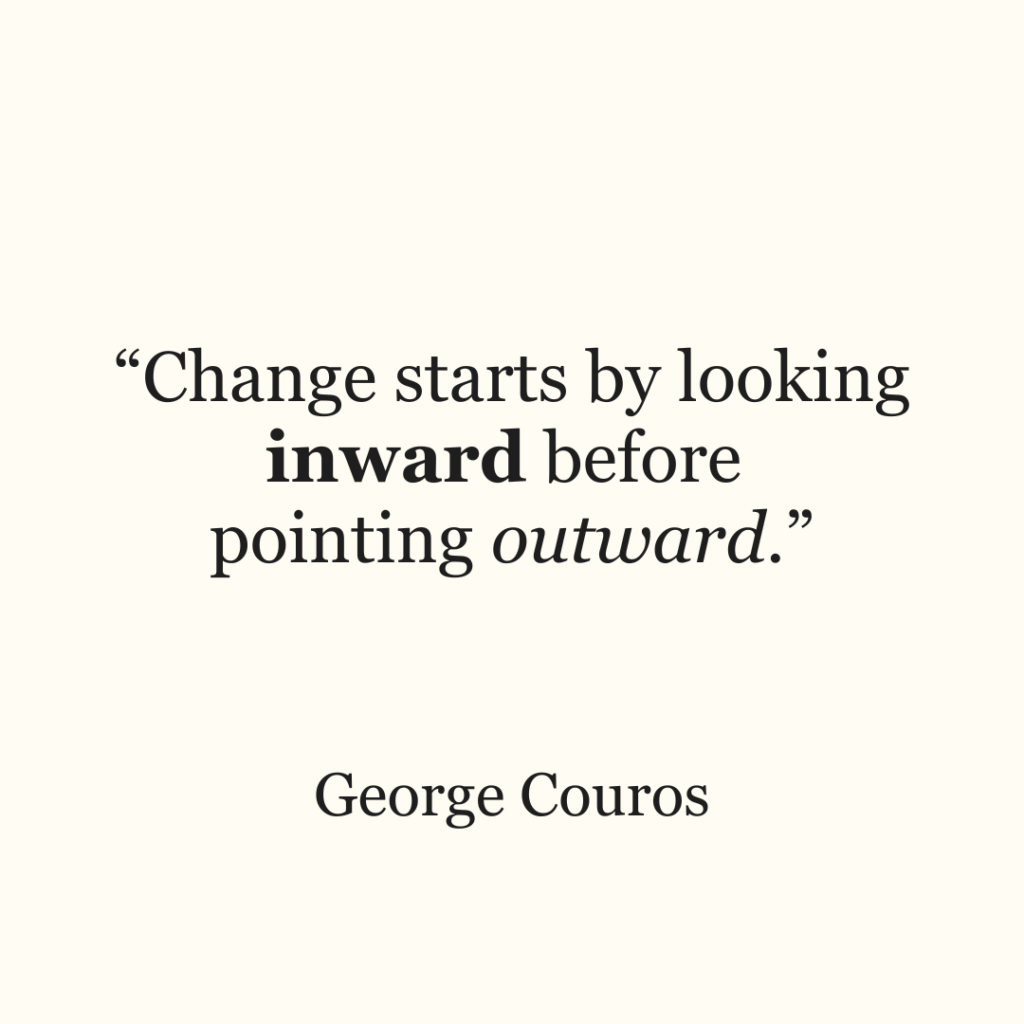
Change starts by looking inward before pointing outward.
Secondly, I have shared how valuable it is to invite different stakeholders into professional learning days when possible. This includes families, students, community members, and more. Again, it helps not only with being thoughtful about how those days are shaped, but also with potential adversaries of new initiatives, when invited to provide input into the process, becoming some of your biggest advocates!
People tend to listen most closely to those with similar roles (teachers listen to teachers, parents listen to parents, and so on), so leveraging the gifts of those who traditionally have not been part of shaping these days can definitely create excitement and enthusiasm for new opportunities for staff and students.
And with that, I encourage you to check out the full post below. If you feel it is relevant to your work, I hope you will consider “Forward, Together: Moving Schools from Conflict to Community in Contentious Times“ if you have not already!
Who is in the room for your professional learning days?
Years ago, I remember being invited to speak at a professional learning day for a school district in Nebraska about the importance of innovation in education and the empowerment of learners.
The district had shared that they wanted students to introduce me and had asked me to provide a biography for them to read to the group. Although I had something I could share, I encouraged them to have students Google me, find out what they could about my work, and write the introduction themselves based on what they found.
They were a little shocked by my response, but since I was discussing how essential it is for students to have a positive digital footprint they create today, what better way to get them to see the importance than by asking them to search for information about the speaker?
The students did exactly what I asked and provided an excellent, thoughtful introduction based on what they found about me online, both personally and professionally.
They received rowdy applause from the staff for their efforts, and as I walked up to thank them, they started walking out of the auditorium, since their day at school had ended.
As they headed toward the exit, I stopped them and asked if they would consider staying. They reluctantly shared that today was their “day off,” and they wanted to head home. I followed up by sharing that what I was talking about directly related to them and their learning experience in school, so their feedback was beneficial and, in my mind, necessary for my own work.
After pleading with them to stay, they said, “Nah…it is our day off.”
With one last try, I said, “When I was driving here, I saw that there was a Dairy Queen a few minutes away. If you stay and it sucks, I will take you all out for lunch there.”
They decided to stay because, to them, it seemed like the easiest Blizzard and Burger they would ever win.
To their shock, they enjoyed what I had to share. As soon as I was done speaking, they approached me and thanked me for my thoughts and hopes for the day.
Not only did they stay for the presentation, but they also joined me in the school cafeteria for lunch and asked me more questions about what I had to share. It was a powerful conversation, but one thing that stuck out to me was what they shared that I still think about often.
One student looked at me and said, “If this is what staff are learning on the days that we are not here, why are they not getting any better?”
It shook me to my core for several reasons.
First, are these professional learning days meaningful to staff and relevant to what they want to learn? Also, is there follow-up and time provided to dig deeper into the ideas and examples shared on these days?
It would be easy to blame teachers for not implementing ideas, but I see it as a leadership problem more than anything else.
If you provide professional learning opportunities during staff days and nothing changes, there is something wrong with the process and implementation, not any individual staff member or group.
I think about this quote a teacher said to me years ago, that guides much of my thinking regarding professional learning days:

Truth.
If people don’t see the learning as “relevant” to their work, why spend time trying to “implement” something new when we often feel we are barely treading water?
I have written about professional learning before, and I think this simple idea could have a massive impact.

The other consideration is when we have the opportunity to have students, parents, caregivers, and/or community members as part of a professional learning days, what doors does that open?
Would we be more invested in our own learning if we knew our community was also there learning alongside us?
Would we be more aware of what and how we shared new ideas with staff, while those outside of the profession but part of our community would be there?
As a school principal and assistant principal, I led zero professional learning days that didn’t include families. We were trying new things in our community and wanted our families to be advocates and empowered in the process.
We often believe that families want school to be the same for their children as it was for them, but I don’t think that. I believe all parents want what is best for their kids.
Yet, if they know of no other school experience than the one they had, they will default to what they did as being “best.”
The goal of inviting families is that they will walk out of these experiences and say, “I wish school were like this when I was a kid!” If you can successfully do that, families will become your most prominent advocates for new opportunities for their kids.
When we are intentional about what we learn, how we learn it, and who is in the room, we can go further together than we could ever go alone.
If you are interested in ways that we can bring communities together to create true ownership (not buy-in) over the direction of our school communities, I invite you to check out my latest book, “Forward, Together: Moving Schools from Conflict to Community in Contentious Times.”
