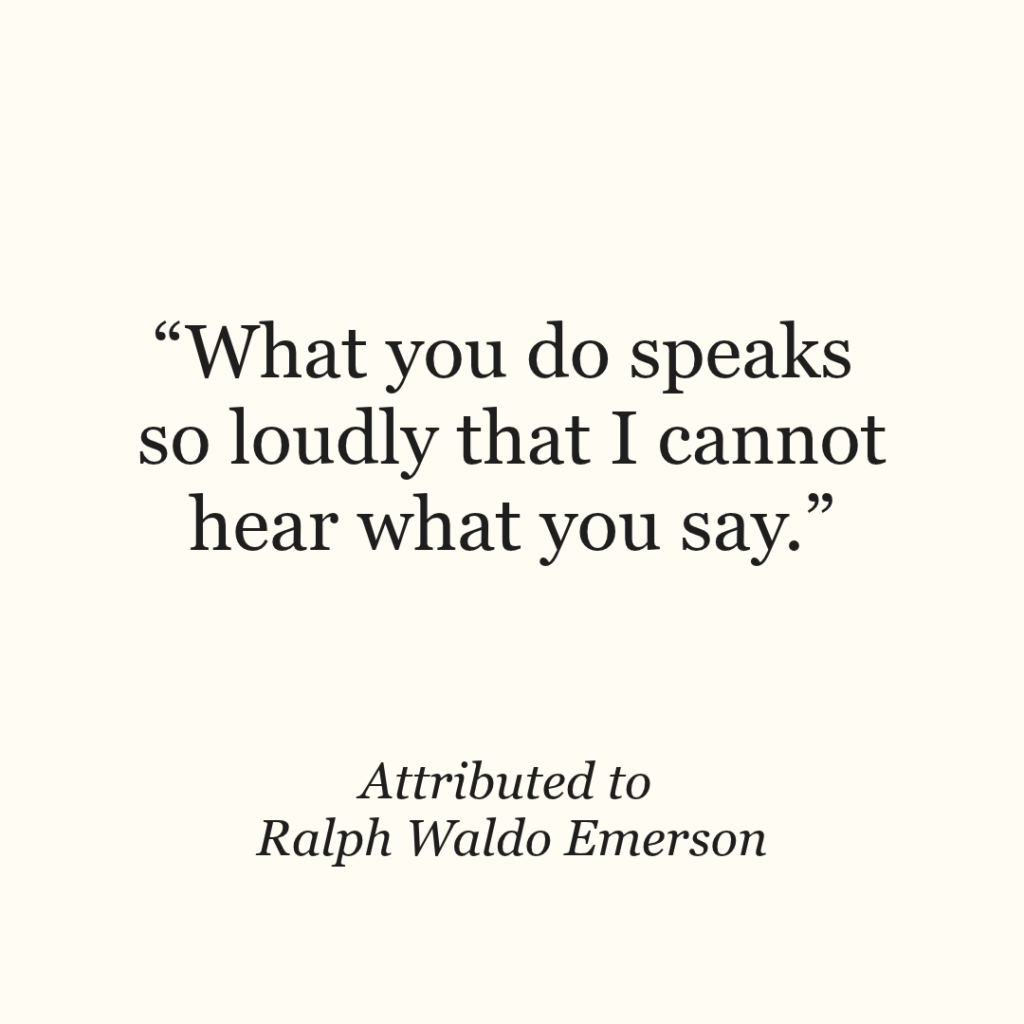
“The kids are watching. What do we want them to see?”
This is a line from “Forward, Together,” and if I could go back in time, I might make a slight alteration. The adults are watching too, and often we have no idea when that happens.
I was reminded of this a couple of times in a couple of conversations after my keynote at the Texas Association of School Boards conference in Houston, Texas, recently.
The keynote was very well received, and I am proud of the “Forward, Together” message, which is constantly being tweaked, improved, and personalized for groups.
After the keynote, there was a book signing, and a few comments stood out to me.
One was a gentleman whom I saw at the hotel t that morning. Both of us were profusely sweating that day and did not know each other. Yet, we acknowledged each other at the gym with a simple nod of respect for getting up so early on that Saturday morning. Little did I know he would be attending my keynote that morning, since there were several events at the conference center.
He came up to me and said, “I saw you at the gym working your butt off this morning! It made me appreciate more of what you said today!”
We dapped each other up and had an awesome moment. One of the things that I talked about was the importance of being present where you are and taking care of yourself. He just happened to see those words spoken in action earlier that morning, even though my intention was not to be an example to anyone else. It gave instant credibility to what I shared.
The next comment came from another attendee, who shared something he appreciated that was not directly said in my keynote. I will get to what he shared in a moment, but first, a little backstory.
Before my keynote on Saturday morning, Inky Johnson was the Friday afternoon keynote. Although I had seen him speak a couple of times, I had known him long before I saw him at a conference, and I knew his voice better than anything.
In 2020, when I really started to get my health back in check, motivational videos and messages would play in my headphones while I was working out, and Inky was one of those voices, although I did not know it at the time. He has had a huge impact on me, so I had the chance to speak to him after his talk. As much as I have put him on a pedestal, he was incredibly grounded and kind with his time.
But I didn’t just go to see him speak because he is a great speaker. I wanted to see what the person before me shared, so I could a) learn from them and b) try to connect their messaging to mine.
At the beginning of my talk, I shared that I loved his message and that the connection between what we had to share was that he pushed people to focus internally and never lose their individual purpose. My message, which I hoped to build upon Inky’s, was that we also need to look to each other, especially when we have different views. His talk was more about the internal, and mine was the external. It was a great connection between ideas, but my focus on intentionally mentioning and connecting the two is important.
Now, I am not always able to see other sessions, but when I can, I do.
I want to know what is going on at the conference, but I am also a student of speaking. No matter how “good” I become, I can always get better. Watching others helps me to become more intentional about my own craft.
Going back to the interaction with this gentleman, he didn’t share any takeaways from my talk, but more of what he saw. He said he appreciated that I not only mentioned Inky in my talk but also that he saw me there the day before, sitting at the front of the room and listening.
One of the principles I share in “Forward, Together” is that we “Learn in a way that we expect from students.” I believe in that deeply, and I never encourage people to try anything I wouldn’t do myself.
But I have seen the opposite.
People are encouraged to embrace their learning by an administrator or politician at the beginning of a session, only to watch that person walk away the second they are done talking. I know people have different responsibilities, but it does say something to an audience, and sometimes it might be better not to come in the first place if that is the message.
Those two interactions really meant something to me that day, but they also reminded me of another interaction I had where someone was watching, which wasn’t as positive.
I often encourage people to challenge my ideas because I know that I can still grow, and that they will challenge them anyway, whether I know it or not. I would rather know so that we can walk through the tension together.
At a conference that I was invited to speak at, a participant pulled me aside and asked me for a moment. She challenged something I shared, and although I heard her out, I didn’t agree.
And that was okay.
But because of my disagreement, the challenges to my ideas turned into personal attacks.
I welcome disagreement, but I also believe there is a difference between challenging someone’s ideas and attacking them personally. When the conversation crossed that line, I made it clear that I wasn’t willing to continue in that direction. I ended the conversation.
I have shared the following idea before and wanted to reshare it with you:
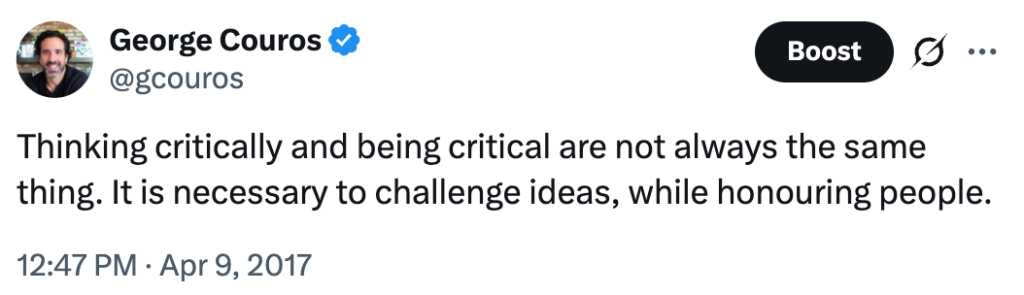
This interaction was not my favorite, and it reminded me of a blog post that Superintendent Chris Kennedy wrote on “Forward, Together,” as well as his own takeaways that have resonated.
Here is what he shared in his post:
“Curiosity is not the absence of conviction. It is what keeps conviction from becoming useless.
This is also a reminder those of us inside public education need to hear about our own debates. We argue about curriculum, assessment, technology, pedagogy, and structures with real energy and sometimes real sharpness. Some of that is genuinely healthy and I would not want it any other way. But the people who care enough to argue about how best to serve students are not each other’s real opposition. There is plenty of pressure on public education coming from outside, from people with very little interest in whether we get the assessment model right or the homework debate resolved. Those of us who have devoted our careers to public education, whatever our disagreements about how best to do that work, are on the same side. It would help if we acted like it more often.
That is part of what makes Forward, Together land the way it does. It does not ask us to give up our convictions. It asks us to hold them in a way that leaves room for other people. And it models that rather than just prescribing it, which is probably the highest compliment I can give any book.”
And why did I bring this all up?
Because this was a one-on-one interaction, and although it was meant to be private, a participant was watching.
She came up to me and said, “I saw what happened and I just want to apologize to you. That was totally uncalled for.”
First of all, she had nothing to apologize for because she had done nothing wrong! But secondly, no matter which side of the discussion she took, she did not want to be associated with someone who resorted to personal attacks to coerce others into their beliefs. There are times in my life that I know I agree with someone’s views, but I struggle with their character, so I pull back. I guarantee you that others have seen me act in negative ways (I actually write about many of them in the book) and wanted nothing to do with my ideas because they didn’t want to be associated with me as a person. I have done my best to work on this.
But all of this, good or bad, is a reminder that it is not just the kids who are watching. The adults are watching as well. And often, we don’t even know it.
And to prove the last sentence, one last story.
I received a gift from my daughter at Christmas, where she had me as the main character in a basketball game, but she opened with this quote:
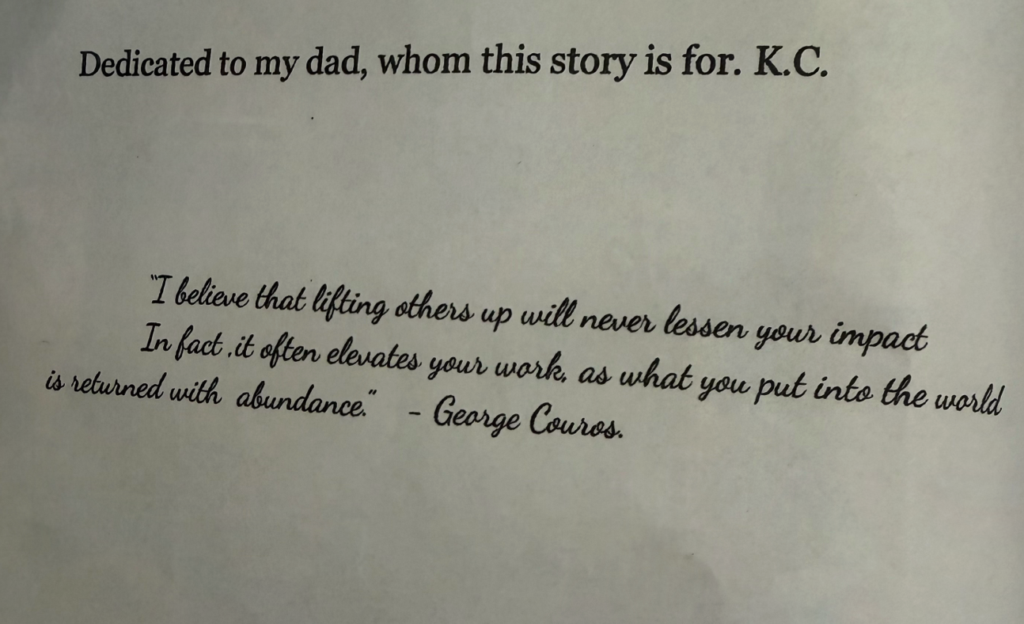
I was shocked that she quoted me, and when I asked my wife how my daughter (9 years old at the time) had known that quote, she replied, “She reads your blog and newsletter every week.”
I had no idea.
When I think about what I post online, I often say it is a living diary I am leaving to my kids long after I am gone. That moment proved it.
A great reminder that people, no matter their age, often pay more attention to our actions than our words, and our watching, whether we know it or not.
We don’t get to choose who watches us and when, but we do control what we do in those times. It is not about being perfect at all times, but having the humility to grow.
The lesson is something that I am going to hold on to and do my best to improve. My daughter provided me with that reminder when I most needed it.
