How can educators help students embrace challenge in a world where
technology makes so many things easier?
When I was in high school and the last child living at home, I would often sleep in the basement so I could watch TV late at night without bothering my parents (meaning, so my parents couldn’t hear me and make me turn it off).
There were infomercials that would come on late at night, for things like vacuums that would cut your hair (not kidding), and in college, I thought the Bowflex was a bit ridiculous (but I still wanted one).
When I would see a commercial like this when I was younger, I thought, “Who would fall for that?”
Probably right before turning 50, I remember having trouble sleeping, so I opened Instagram and saw an ad for a cream that would get rid of my love handles, tiredly ordered it, and woke up to a receipt in my inbox. In that moment, I realized who would fall for that.

You see, working out and eating healthy isn’t that hard when you do it for one day. It is the consistency and discipline of doing it over and over again, without seeing immediate results, that is hard.
But “love-handle” cream remover seems easy. But I hate to tell you it didn’t work.
Now, there is a reason I am bringing this all up.
![YTP] Billy Mays Sells Everything and Nothing on Make a GIF](https://i.makeagif.com/media/4-06-2017/yUApGZ.gif)
I am about to head to a coffe shop and write a post on my blog, which I have done for almost 20 years consistently at least once a week (that is hard), only to see this video clip on Instagram shared by Ted (Not the Teddy Bear movie, the organization) of the latest Jonathan Haidt Ted Talk on “Why You Should be a Techno Skeptic.”
This is the clip below:
View this post on Instagram
Immediately, when I see the thumbnail, I roll my eyes because I know this will come up in a future speaking engagement.
There will definitely be a challenge with something I say in my talks regarding technology, as there has been in the past.
When I speak, I am definitely not a “Techno-Skeptic” nor am I a “Tech-Absolutist” or a “Tech-Optimist.” But maybe it is because I am “Techno-Curious.” (I will get back to this term later.)
And then I buckle down and start watching the video, because ignoring it and pretending it doesn’t exist would be easy.
Watching it, seeing what Haidt says, and making sure I am thoughtful about it is more important, but it is hard.
So I watch it.
And something Haidt says in the approximately 90-second video hits me hard. I want to share the entire context of the talk, but for now, I will bold below what really stood out to me from Haidt.
“All right, now I’ve just told you that we need to greatly reduce the role of these technologies in our kids’ lives. And some of you may be thinking, “Oh, hold on a second. I want my child to be successful in the digital future and the digital workplace. So why not give them a head start?”
Two reasons.
The first is that these technologies are extremely easy to use. Your kid doesn’t need a 10-year head start to master social media and AI.
And second, … is that being a digital native does not confer an advantage. For many kids it’s a curse because it messes with [their] attention systems and their motivational systems. It teaches them that there’s always a little bit of reward, a little bit of dopamine available, just one swipe away. And that undermines the ability to do difficult or sustained cognitive work like reading a book.”
Jonathan Haidt
I will get to the bold part in a second, but I want to address something in the above statement first.
It is not just the kids who are struggling with technology.
The “ability to do difficult or sustained cognitive work like reading a book” is also an issue for many adults.
In a recent conversation, I spoke with an administrator who said, ‘I don’t have time to read books.’
We are all busy, but is it a matter of availability of time or the ability to sustain our attention?
Some adults might scroll this content, see how long this blog post is, and think, “I don’t have time to read all of that” (you should try the time in writing it!), but how much time is spent scrolling mindlessly?
In fact, when I share this post with an image of a quote as a “teaser” along with the link, how many adults in education will reshare, like, or comment based on the quote in the image, without even reading the text? (It happens all the time.)
I have been challenged on blog posts in social media comments, where someone argues something I agreed with in the post; they just never read it.
I will even give you a bit of evidence from the post itself.
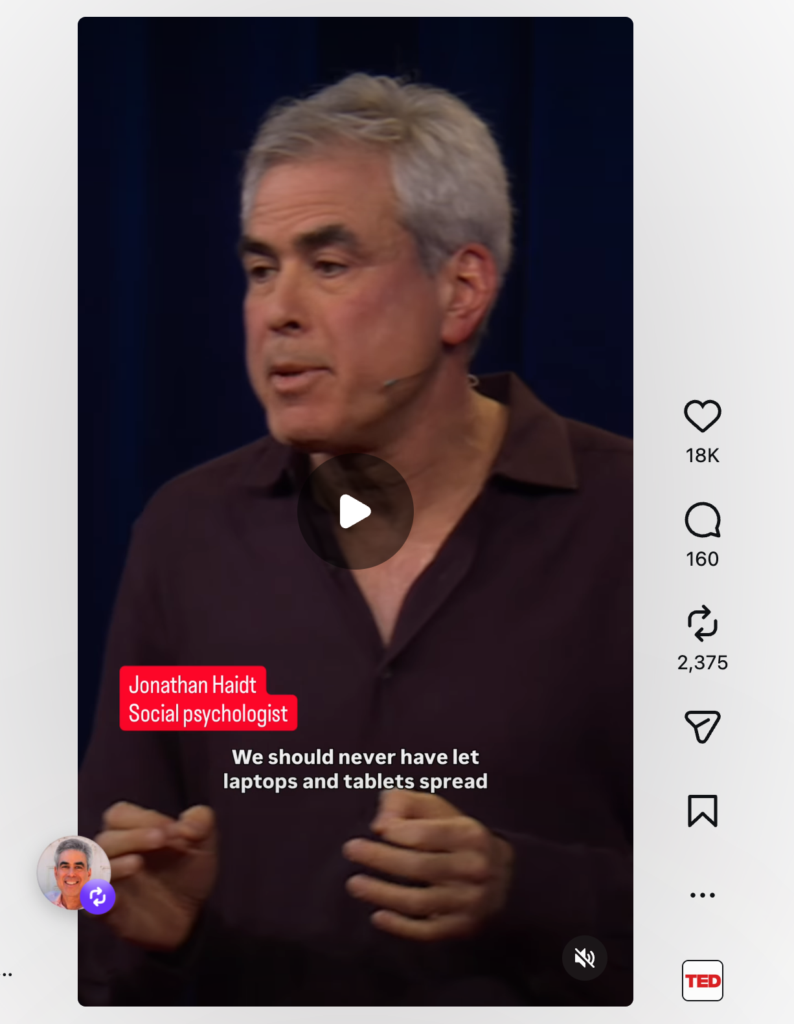
Here is a screenshot from the approximately minute-long video on Instagram as I am writing this:
And a screenshot of the number of views of the entire talk on the TED website at the time of writing this:

The entire video was 5 days old when I wrote this, with 11,139 plays, while the Instagram video had been posted for less than 24 hours and had at least 18,000 likes. We also know that 18,000 likes doesn’t necessarily translate into views, but it also doesn’t mean that the 18,000+ people who “liked” the video watched the whole thing.
The irony of all of this is that TED posted a video featuring a speaker concerned about diminishing attention spans on a platform (Instagram) that has both leveraged and partially created the issue in the first place.
And no offense to what is shared in the video, but I am doubtful that it is a bunch of high schoolers voraciously consuming TED content en masse (although some are definitely checking it out). Some, maybe, but it is likely to be mostly adults.
What was interesting was that when the TED videos first came out, the idea that fascinated people was that these lectures were limited to 18 minutes, which people thought was fairly short. Now, they seem to be 17 minutes too long.
So the attention span is not just a kid thing.
Ironically, in the last five years, I have read more physical books than in the 45 years prior. I have had a couple of decades where I felt comfortable writing on a device, but it has only been recently that I have read more physical books.
At first, that transition for me was tough, but it wasn’t going back to something I moved away from and came back to. It was the first time I ever started something. Physical books were never of interest to me, and I was always perplexed by people who loved the “smell of a book,” and often wondered, “Why are you sniffing books?” I started reading physical books not only because of my own interest, but also because of the calming effect it had on me, and because I recognized the importance of modeling my own reading to my three kids.
Which leads to my second point.
“Easy” is part of the problem.
This quote from the Instagram video shared from Haidt hit me like a ton of bricks:
“The first is that these technologies are extremely easy to use. Your kid doesn’t need a 10-year head start to master social media and AI.”
He is right. The technology is easy.
Here is some evidence from my experience facilitating groups.
I used to teach educators how to leverage social media, but back in the day, I taught them how to create a Twitter account.
I will give you that entire part of the workshop.
“Hey everyone…we are going to create Twitter accounts. Here is what I need you to do. Go to Twitter.com, and then look for the button that says ‘Sign Up.’ Once you see that, click that, and then fill in the blanks.”
That’s it.
Because that is all you had to do.
That is easy.
Do you know what is hard? Building a network, leveraging it not only to make connections, but to improve opportunities for your own students, whether that includes technology or not. That took time and effort. It was hard.
The “easy” of technology is part of the reason why you have to teach students.
Do you know what is easy?
Arguing with someone over text, or even sending a mean message.
Do you know what is hard?
Having a tough conversation, either in person or over a phone call.
I will give you an example.
I mentor someone, and when we first met in his early 20s, I would give him some advice, and he talked some smack to me in a bit of a disrespectful way. It bothered me, so I would pick up the phone and call him. Some of the “toughness” exhibited in the text quickly softened. He shared with me that as soon as he saw my number after texting me, he would get a sudden sense of anxiety, as this was not his typical way of dealing with things at his age.
This goes back to the Bill Simmons quote I have shared frequently: “Some of the biggest muscles are Internet muscles.”
I have also flexed my own in the past.
In “Forward, Together,” I share a time I harshly criticized a presenter while they were speaking on social media during the day, only to unknowingly have to sit down with him at dinner that same night.
Blasting him on social media when I didn’t know him? Easy.
Sitting across the dinner table and seeing the effect of my words on him? Hard.
It was a lesson I needed to learn AS AN ADULT.
Thank goodness there is more to the story in the book, but I am better off because I had to sit across the table and see the repercussions of my actions on social media, in person. Honestly, I would have never thought much about it if I hadn’t had that dinner with him and saw the damage I had done. I hated that I did that, but I am glad I experienced my own discomfort, because it made me think about how I wanted to move forward.
I have challenged ideas since then, but I have been very careful not to make it personal.
And I have seen other adults do that as well.
Which is why the “easy” of technology is the issue we need to address.
Reading this blog? Easy.
(Although the longer it is, the more people will not get through it, no matter the quality.
Writing this blog? Not so much.
Watching a YouTube video? Easy.
Creating a YouTube video where you teach others a concept? One of the best ways to learn is to teach it to others.
Doing the “hard” stuff benefits not only learning but also growth as a human being.
Has doing the easy thing with the implementation of technology in schools created this issue in the first place?
Watching the entirety of the Haidt talk, there is much I agree with, and because I have been writing for so long, I have, as the kids would say, the receipts.
Dumping technology in schools without much thought on the impact on learning? Easy.
In September of 2012, I wrote an article for Edutopia titled, “21st Century Schools or 21st Century Learning?” Here is a snippet of what I wrote:
The mass purchase of devices for schools is happening way too often without conversations with educators about what learning should be happening in the classroom. This is actually frustrating many teachers that I have spoken with; it just becomes another thing being dumped on educators, not something that is going to make learning better. There is definitely some value in playing with a device and figuring out the wonderful things it can do, but should we really buy these en masse for that purpose? Shouldn’t we try to figure out what the learning looks like and then discuss the device? It seems sometimes that we are doing the exact opposite.
Let’s continue to focus on the learning but really focus our time when we get together to figure out what it should look like. We can figure out the devices later.
Do you know what was hard?
Bringing staff together to have meaningful conversations about what the learning could look like with the teachers who would lead it in their own classrooms, and how we can focus on and create deep learning opportunities for staff (first) and then students, rather than tools. That took time and effort.
In “The Innovator’s Mindset” (2015), I also, in a way similar to Haidt, advocated that we shouldn’t just throw devices into the classroom without first understanding the opportunities for adults.
Here is that portion:
If we want to do better things for students, we have to become the guinea pigs and immerse ourselves in new learning opportunities to understand how to create the necessary changes.
But that is hard. And takes time.
But then we aren’t undoing messes later because we skipped the meaningful work.
Moving Forward
A couple of last things.
The technology is so easy to use, which is why it is important to teach kids how to use it in purposeful and meaningful ways.
Here are a few examples I thought of that I struggle with in my own life.
Paying with Apple Pay on my phone? Super easy.
Actually, considering if I need to buy something (love handle cream) is a good buy? Effort.
Resharing a post on social media based on a quote without reading the article? Easy.
Reading the entire article and writing a thoughtful response? Hard.
Consuming content that totally agrees with your view? Easy.
Consuming content that will challenge your view and being open to altering your thinking? Hard.
Almost 16 years after starting this blog and publishing close to 2000 posts, the writing still takes time, but in many ways has made other things easier.
Part of the reason I am writing this here is that I know it will come up in a conversation later. I want to be able to adequately address it with an abundance of information, rather than a place of scarcity. Wrestling with the ideas here will not only help me articulate what I believe, but also better understand others’ viewpoints. A hard task, but necessary if we want to figure out ways to move forward as a community and society.
After seeing the initial 90-second video on Instagram, I watched the entire TED talk (18 minutes), and I am going to write a part 2 to it because there is a lot I agree with Haidt on, and some places where we disagree.
That post is coming up.
But I want to address one last thing in this post that I referenced earlier.
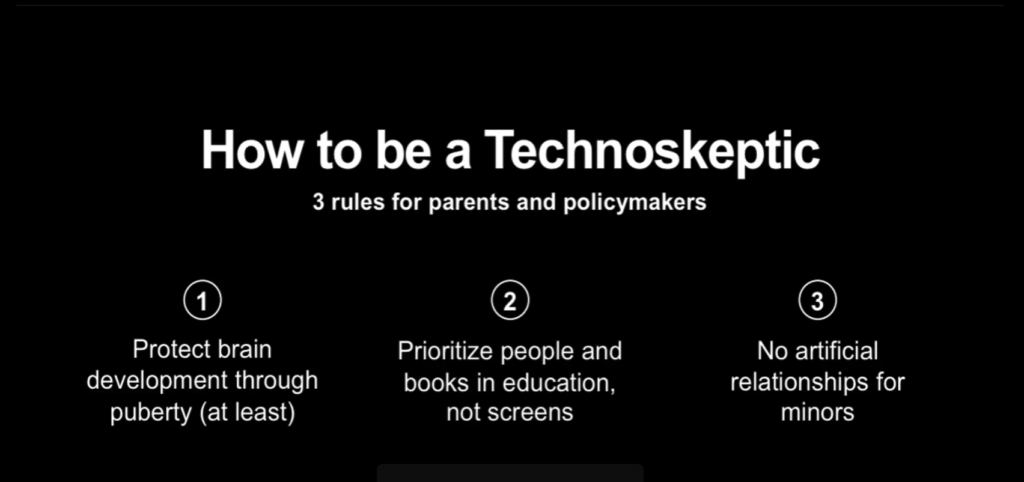
Haidt’s talk is titled “Why you should be a techno-skeptic,” and I half agree and will go further into his three main points in the follow-up post.
In “Forward, Together,” I shared that “Curiosity is part skepticism and part wonder.”
The basis of that quote is that you should wonder about opportunities and be excited about the future (wonder), while also challenging ideas, even if you believe and already agree with them (skepticism).
That is hard for many, including, and maybe especially, adults. As I age, it is hard not to be stubborn about things I have believed in the past, to change my thinking.
Being “Techno-Curious” is not only seeing the opportunities, but also the pitfalls.
Understanding different viewpoints can be hard.
But for years, I have gone in search of those ideas I disagree with to understand them better, and the more I have done it, the easier and more thoughtful I have become.
So yes, the technology is really easy, and kids can learn it later. But the ease of technology is the problem in the first place.
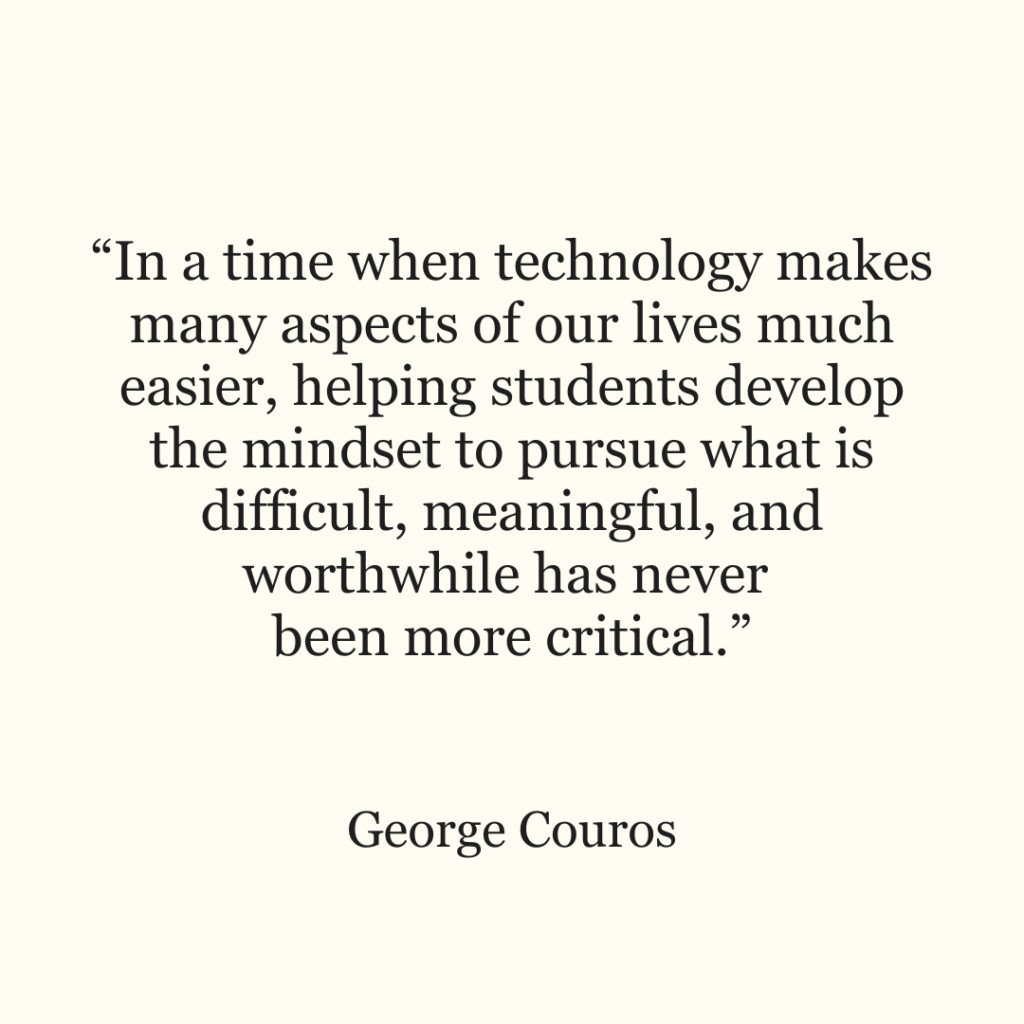
In a time when technology makes many aspects of our lives much easier, helping students develop the mindset to pursue what is difficult, meaningful, and worthwhile has never been more critical.
More to come…
