There are two main reasons you should use technology in school: to deepen learning and build human connection.
If you don’t leverage it to do either of these things, I don’t see the point.
But this is also up to the “user,” not the tech. How you leverage technology is more important than the technology you use.
And I try my best to use technology this way based on this one belief: if you can make someone’s day better, you should.
The beautiful thing about the access we have to technology and all its possibilities is that it is easier than ever to make a person’s day in a way that matters to them.
I thought about this after a keynote to a group in Texas, and an interaction I had immediately following my presentation with a teacher who was also a mom.
In “The Innovator’s Mindset,” I share the following story, which I have told in a variation to audiences for a long time, and on this day, it resonated deeply with this mom.
I had just walked off the plane in Roanoke, Virginia, and was headed to a hotel to speak at a conference. Instead of getting a car, I decided to take an Uber to the hotel since it was a quick trip. My driver showed up, courteously grabbed my bags, placed them in his trunk, and then opened my door for me. As we set out, I asked him if he knew where the hotel was, but he didn’t respond. I asked him again. No response. I then tapped him on the shoulder, and he looked at me, surprised, and mouthed the words, “I’m deaf.”
As we drove, I thought about how technology had provided a great opportunity for this man to create a career for himself. Driving a vehicle, he didn’t need to know the directions to the hotel because they were automatically updated on his mobile device. He knew what I looked like from my Uber profile. Upon arriving at the hotel, I mouthed, “Thank you.” He thanked me back, and we went our separate ways.
Later that night, I saw a post on the image-sharing site Imgur about another person who, when he discovered his Uber driver was deaf, did a quick Google search to learn how to sign “thank you.” The driver was overwhelmed by the man’s simple kindness of communicating with him in sign language. After reading the story, I felt annoyed that I had missed an opportunity to show my appreciation for someone who had provided such excellent service to me. The day after my talk, I arranged an Uber ride back to the airport and was lucky enough to get the same driver. As with the other day, the driver provided the exact same high-quality service. Remembering the post I’d seen, I spent my time in the back of the car learning how to sign “thank you.” I did a Google search and then watched a video on YouTube to ensure I had the correct motion. At the airport, the driver took my bags out of the trunk and placed them on the curb. This time, instead of simply mouthing the words, I signed “thank you” to him, hoping I was doing it right. The expression of gratitude on his face shook me. It was simple and only took a few minutes to learn something that showed I valued my fellow human being.
Why did I do this? Honestly? Because I could.
The power we have at our fingertips to learn and create is awe-inspiring. There are many parts of this story that I could not have told in 2000—YouTube, Uber, accessing Google from a smartphone—but, today, these technologies are abundant and ubiquitous.
It is amazing to consider how much has changed since I wrote this story, and how much has stayed the same. Technology is moving at an exponential rate, but our ability to leverage it to connect with others in a way that matters to them is still up to us.
For example, ChatGPT did not exist when I wrote that book, but I now use it to practice some Greek phrases and try to share some of that learning with my mom. Greek is her first language, and I know she loves it when I try to connect with her in the language she grew up with.
Technology is the variable; being human is the constant.
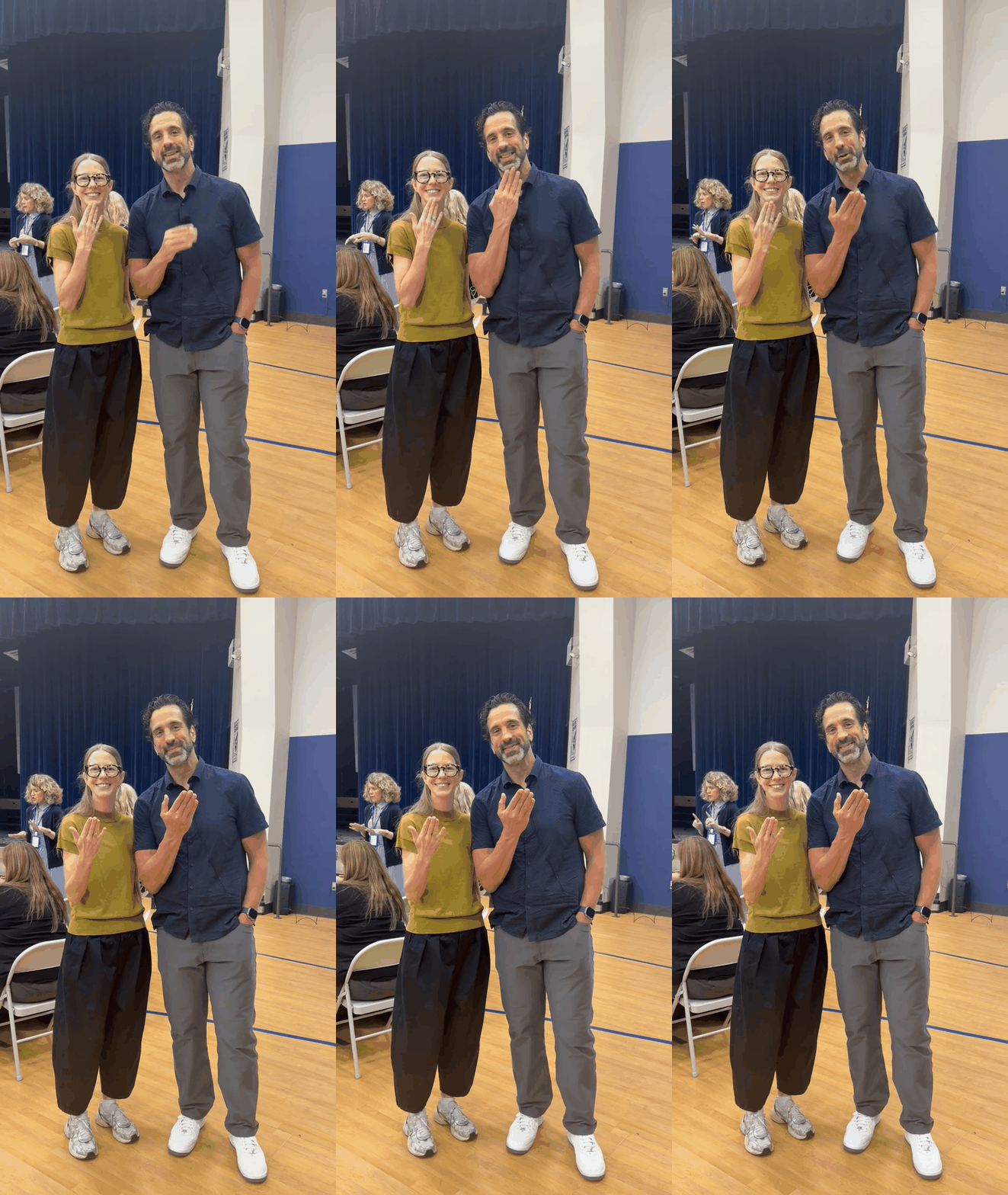
But on the day I shared this story with this group, a woman approached me, and before she even started speaking, I could see tears in her eyes. With her permission, I am sharing a bit of a conversation from my recollection.
She looked at me and said, “You have no idea the impact you had on me today. That Uber story you shared really hit me, and I love that you did the sign for ‘thank you’ in your keynote.”
If you know me, I am a bit of a crier. And by a bit, I mean a lot.
And if I see someone else crying, it is contagious. So she continues as I start welling up myself.
“My daughter is entering kindergarten in school this year, and she is deaf. I have been nervous about her experience, but that little gesture you learned and made not only made an impact on that driver. It made an impact on everyone in this audience today who saw you make that gesture and then go out of your way to connect with someone in a way that was meaningful to them. It can make all the difference. Thank you!”
And that pushed me to an ugly cry!

And as much as thinking about how we use technology to connect with others feels very in the spirit of “The Innovator’s Mindset,” it is just as much “Forward, Together,” and the theme in how we build community in intentional ways:
At the heart of this book is a deep belief in community. A special kind of community that makes schools not just places where students go but spaces where families feel welcomed, cultures are celebrated, and everyone plays a role in creating something meaningful. That kind of community doesn’t happen by accident. It happens when school leaders are intentional about inviting others in, sharing ownership, and building a culture rooted in respect and belonging.
And here is something I think is really important to note. I have no idea how good my sign was that day, or if I messed it up a bit. But I tried because it mattered. As my friend Meghan Lawson shared, “We need fewer shiny, perfect people in our schools and more deeply human ones.”
The effort, with its imperfections, matters more than not trying to connect at all.
We can use technology to bring people together or to divide them. I choose the former.
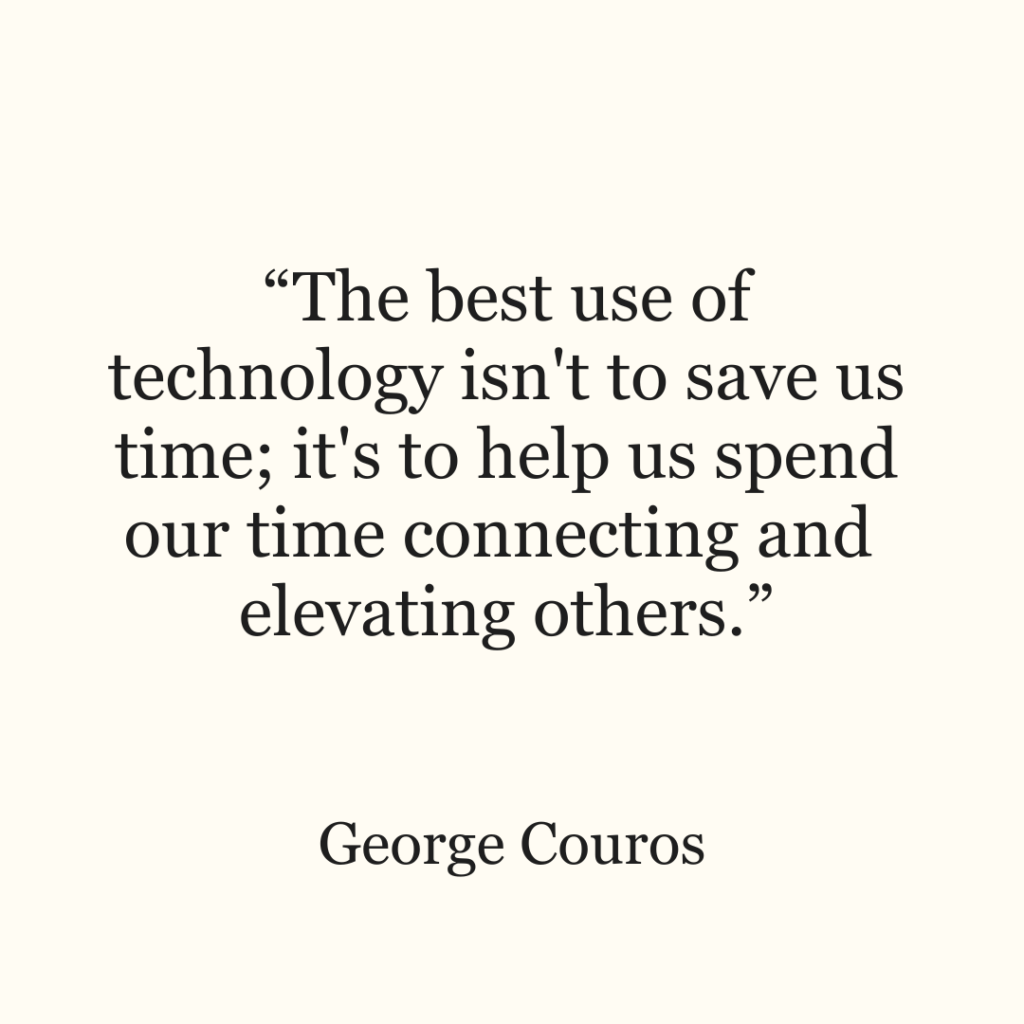
After this interaction, I realized the following: the best use of technology isn’t to save us time; it’s to help us spend our time connecting and elevating others.
That interaction will stick with me for a long time, and I know that teacher and mom made me better that day.
One last thing.
If you are still reading this, I just wanted to let you know something.