“In some cases, traditional practices may work great for some learners, while more modern practices may work better for other students.
If, for example, your school gives every student access to a mobile device, but you have a student who thrives with the use of pen and paper, don’t force that student to go exclusively digital.
Whatever individual learners need to succeed is where we begin. Innovative teaching and learning is about creating opportunities that empower all learners—including us—to thrive.”InnovateInsideTheBox
I was tagged in a post sharing the above quote, which I wrote in “Innovate Inside the Box” with my good friend and colleague, Dr. Katie Novak.
There is a lot of conversation right now about returning to certain elements of education or moving away from past practices. Examples such as thinking every student should always use paper and pen, or, at the other end, emphasizing the heavy reliance on AI in the classroom. In both of these extremes, the focus seems to be more on the technique than on any individual learner.
That is where I become concerned.
The concern has nothing to do with the generation of the idea; rather, who is the learner we are focusing on supporting?
As Jeff Utecht shared in his book so precisely, “Human Still Required,”
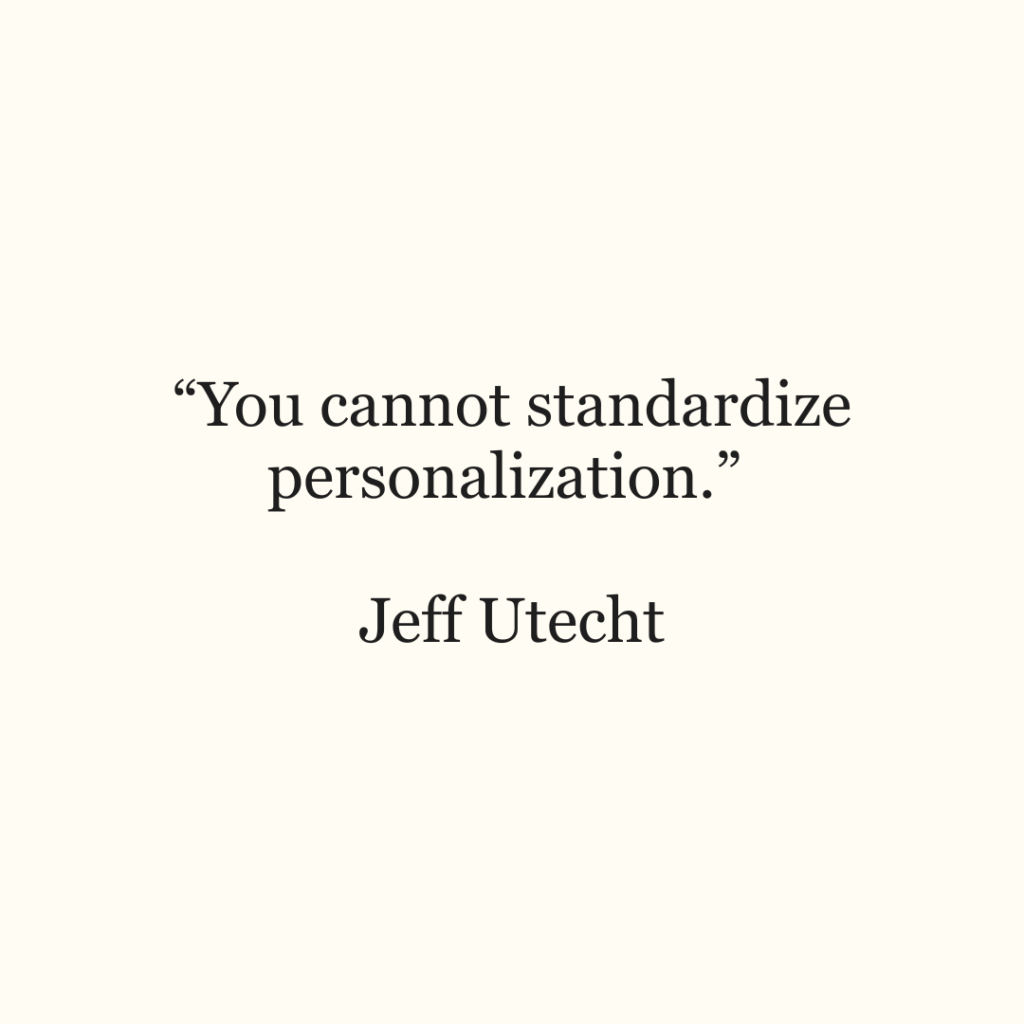
That makes a lot of sense to me.
(Here is a post I wrote in 2021 regarding “4 Questions to Support a Student’s Path to Personalized Success” for your reference.)
I just want to share a few examples that came to mind as I write this.
1. Recently, I had a conversation with a teacher about how we might leverage technology to hear from voices in our classroom that we might not have heard before.
When I was a student, I always think of one friend in my class who would NEVER talk out loud, yet was one of the most intelligent people I know to this day. I did not grow up in a time with cell phones (or whatever we call them today), so it wasn’t that he didn’t know how to talk. He just hated talking out loud. And no matter how many points you were going to deduct from him for not talking, he was not going to do it.
Fast-forward to today, and there are still students (and adults) who are like that.
They are perhaps more introverted than others, and that is okay. But if we leveraged different ways for them to share their voices that might be less traditional than past practices, I see that as a good thing.
Where the conversation seemed to go astray was that the teacher said something along the lines of “I get them to talk.”
To be honest, it made me feel uncomfortable, but I also used to have the mantra that you will adapt to how I teach, rather than I will adjust to how you learn. That was my perspective early in my career, and it changed.
Of course, the hope is for students to become better because of our teaching, but that doesn’t mean making them into something they are not, or even that we think they should be. It is about helping them find the best version of themselves. There are more ways to do that than ever.
This leads to the second point.
2. Many classrooms embrace flexible seating, and I have witnessed classrooms outfitted with traditional desks, couches, high and low tables, and even bouncy balls. The point of this seating is not to let students sit wherever they want, but to help them find the arrangement that best supports their learning.
If I were in a classroom with a couch as a student, I would gravitate toward it immediately. I would probably do nothing the entire time, but that doesn’t mean I wouldn’t still try to sit there.
As I write this post, I am sitting at a high table in a Starbucks, standing and sitting to help with my restlessness and (lack of) focus. I can’t explain why sitting at a high table works, but I just know it does.
I also need a distraction from isolation.
When I write, I like seeing people in my peripheral vision, but I have headphones on to block out distractions. Again, I don’t know why this helps me, but I know it does. Probably 90% of my writing over the past 15 years has been done this way, and it has helped my output.
But I learned all this as an adult, on my own.
Those traditional desks might have (and still could) worked for some, but far too often, with my tall frame, my focus would be on my knees hitting the top, and I would feel discomfort in a seemingly claustrophobic space. My oldest daughter seems to love that type of desk for her own learning.
Again, the focus is on helping the student become the best version of themselves and, ultimately, not on having them do whatever they want, but on helping them figure out what is best for their own learning.
That is the best thing you can equip a student with when they leave the school. The understanding of how to continuously learn on their own to the best of their abilities.
3. And what works for you might not work for others.
Years ago, I was in a professional learning day, and was enjoying the speaker. I noticed that she headed my way, walked up behind me, and told me that it was disrespectful for me to have my laptop open while she was speaking. Ultimately feeling confused, I turned my computer around and showed her the post I was working on about what I was learning in her session. I honestly can’t remember what happened after that, but I do remember it was awkward!

What I also noticed was that she said nothing to the person who was doodling on a notepad beside me.
Pen and paper, good. Technology, bad.
When I brought my perception of unfairness to my colleague, noting that she wasn’t even learning herself on the notepad, she shared that the doodling was a way for her to process her own thoughts. Again, I have no idea why it worked for her, but it did. What we perceive as disrespect or perhaps a lack of attention might be a misperception of how others learn.
I have been guilty of saying to students, “Eyes up here!” when I felt they were not paying attention. In some cultures, direct eye contact is considered disrespectful.
That also made me realize that when I am “listening” to someone, I often turn my head to the side because I do not hear as well in my right ear. Yes, I can sometimes drift off (not intentionally!), but when I really want to listen, I tilt my head. What works well for one might be the opposite for another.
Now I bring up these stories of differences in individual learning, knowing that it is extremely complicated to provide these opportunities in large classrooms, and a system that advocates for personalization, while creating every action to move away from it (this is one of the reasons I recently wrote about class-size).
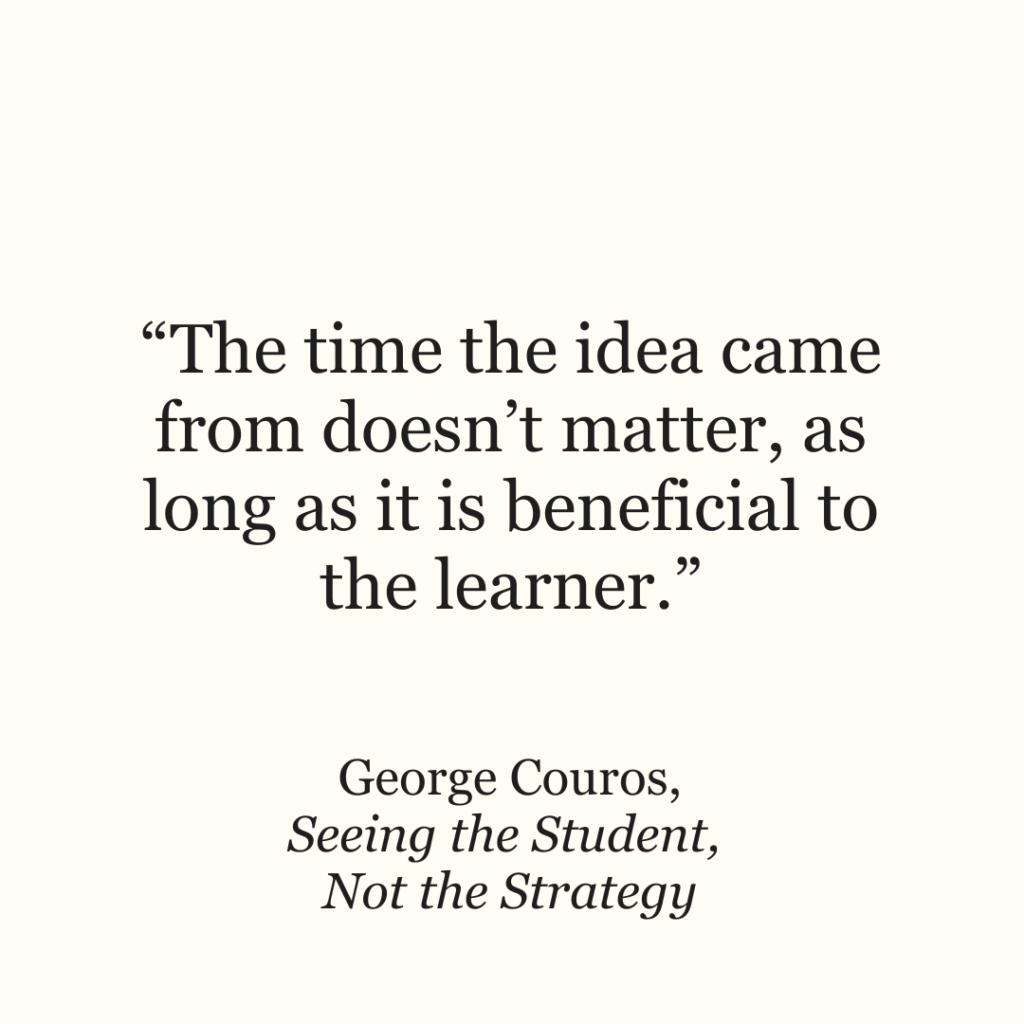
I still believe that if you are using a teaching practice that existed 100s of years ago and it works for kids today, you should still use it. On the other hand, we should never use a “new practice” just because it is new; only if it works. The time the idea came from doesn’t matter, as long as it is beneficial to the learner.
But it is also important to recognize that what works for one might not work for others. If a practice is known to work for “90% of students,” my question becomes, what about the other 10%?
When we focus on moving backward from the learner rather than on a specific practice, we are more likely to find success as schools.
If you want to check out “Innovate Inside the Box,” which explores the core of innovative teaching and learning and different strategies to bring out the best in each learner, you can find it here on Amazon!
