Do you know who does a great job of recruiting new teachers to enter your organization?
The veteran teachers who are on their way out.
But that is dependent on how they are treated.
Have you ever seen an ad or commercial that shares all of the incentives to become a new customer of their service?
“If you join today, you will get ALL of these benefits of being a new customer!”
And although that is enticing, it is pretty easy to be good to people at the beginning of anything. Whether it is a personal or professional relationship, the beginning is the easy part.
When things get tough, is when you find out the “benefits” of being associated with an organization.
And the longer someone is there, the more they will talk about your organization, good or bad, and everything in between.
An organization’s reputation is less about what new customers or employees feel than about those who have been there the longest.
A good friend of mine recently shared some great insights on the importance of being a team, but one thing stood out to me in a different way, and I didn’t necessarily agree. She said, “The team comes first,” and although I know she didn’t mean work goes before family, too many have felt that the expectations of our employees are that the organization comes first, and the second you leave, you will be replaced.
If the individual is replaceable in a team, the team should not come first.
I can be a principal, and then leave, and I will be replaced by someone else who will hold that title.
This is true with almost every organization.
Nick Saban, the former head coach of the Alabama college football team, considered to be the best college football coach of all time, was replaced within 49 hours of resigning.
An organization can and will replace you.
But I can’t be replaced so easily by my family. (Right?!?!?)
There is a story I heard about former NFL coach Bruce Arians and how he communicated with his assistants that if they “miss a recital or a football game or a basketball game, I’ll fire you.” In the same article, Arians shared, “You can always come back and work. Those kids are not going to be there forever. They’re going to grow up and be gone.”
Here is the interesting aspect of this type of leadership.
When you are encouraged to be more present in your personal life, you want to do better in your job. If I am treated with respect and appreciation as a person, I want to do better for that same employer.
In what was probably my best year of teaching, my principal (who is my favorite leader of all time) treated me so amazingly well that, sometimes, when I was doing extra things late at night for the school, I would think, “How is she getting me to do this?!?!?” In reality, she cared for me as a person outside of the organization, and I wanted to do better within it.
Yet, the toughest part of how you treat the people there is that it has to be consistent over time. It can’t be just the beginning, middle, or end, but all three, especially the last.
I once heard someone share that a person can be with an organization for decades, but ultimately, they will judge that entire experience based on their last three months. It seemed ridiculous at first, and then I thought about it, and that is totally how I felt in my roles.
The entrance is noticed, but the exit is remembered.
And if you treat those people with respect and appreciation while they are there and as they transition into the next phase of their lives, they become your biggest advocates and your best recruiters.
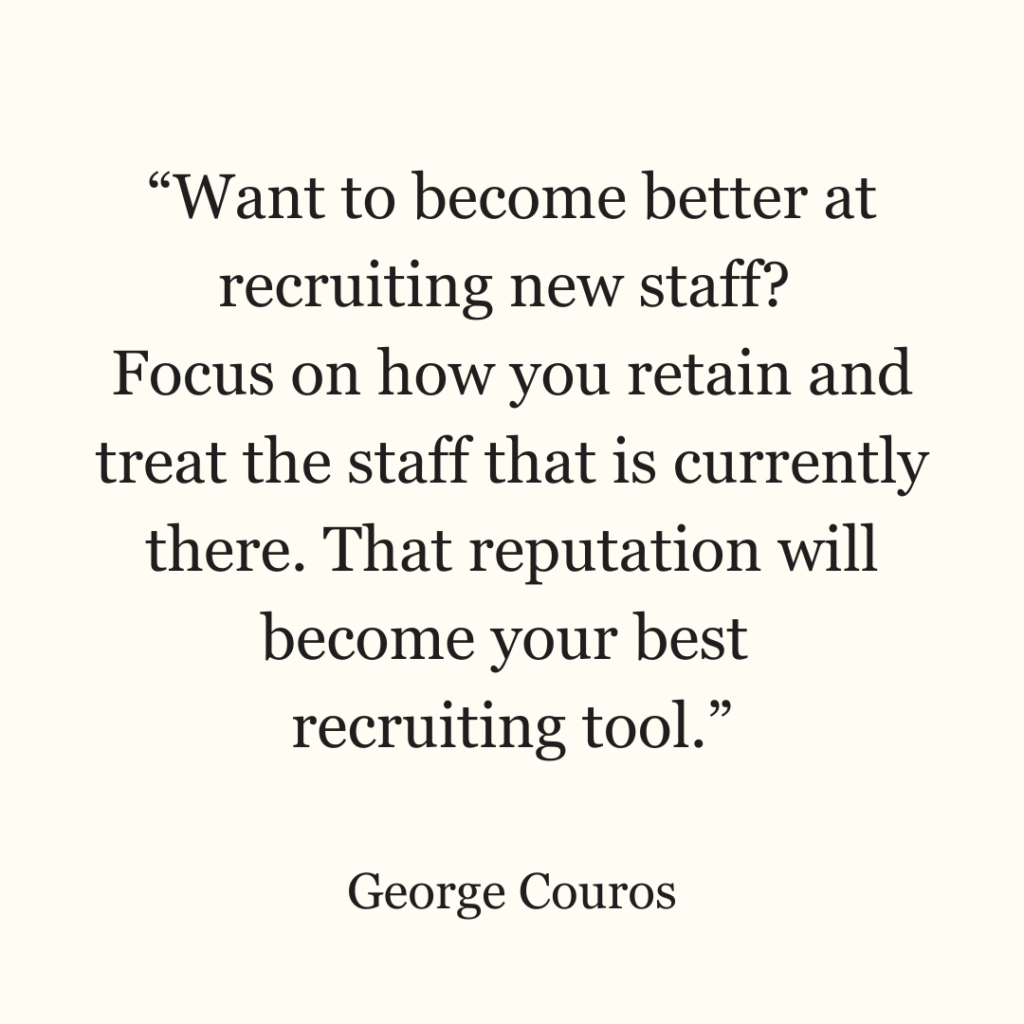
Want to become better at recruiting new staff?
Focus on how you retain and treat the staff that is currently there. That reputation will become your best recruiting tool.
View this post on Instagram
