Here is a thought that has been ruminating in my mind regarding AI and the purpose of education.
A statement we have heard for years is, “We are preparing students for jobs that do not currently exist.”
With AI, what is more likely true:
We are not only preparing students for jobs that don’t currently exist, but also a workplace where many jobs will no longer exist.
To some extent, this has always been true, but it will be more so than ever.
Think of Uber.
I once heard a story about how Uber became Uber, not because it was the first ride-sharing company, but because of the timing of its March 2009 launch.
Do you know what happened the year prior? The 2008 financial crisis.
Immediately, you had an abundance of people who were without a job but had a car. To start a ride-sharing company, you need drivers.
That disrupted the car-service industry.
Soon enough, those driver jobs that didn’t exist and came out of nowhere will no longer exist.
Uber is moving to autonomous vehicles, and this is already happening in several cities across the world.

As you can see, this is already happening quicker than ever.
This article, “Entry-level jobs vanish as AI rises,” shares the following:
“Employers are drawn to AI for its efficiency, as it can complete tasks in a fraction of the time it once took human teams. This shift poses a threat to the traditional career ladder, resulting in a shortage of trained candidates for senior and managerial roles in the years to come.
Young professionals can counter these trends by acquiring practical AI skills, even outside of technology sectors. Combining human strengths, such as strategic thinking, with AI proficiency may help early-career workers remain competitive and adapt to evolving workplace demands.”
Having the ability to learn no matter what comes our way, adapt, and pivot (OMG that word has Covid vibes, ewww!), is going to be crucial.
The ability to learn, no matter what comes our way, is more crucial than ever.
And it has to be instilled in students.
Yet, as I have continued to argue, foundational skills are more critical than ever.
When I thought about the one thing schools need more than ever, it is not “AI Ready” students. It is the ability to read, write, and perform basic numeracy.
Foundational before aspirational.
Yet, if you were to build a house and only build the foundation, you wouldn’t have a home. You have a great start, but it is not a place you will be able to live in the future.
Foundations are meant to be built upon.
I share all of this after I saw this tweet being shared by Adam Grant, which was shared by many:
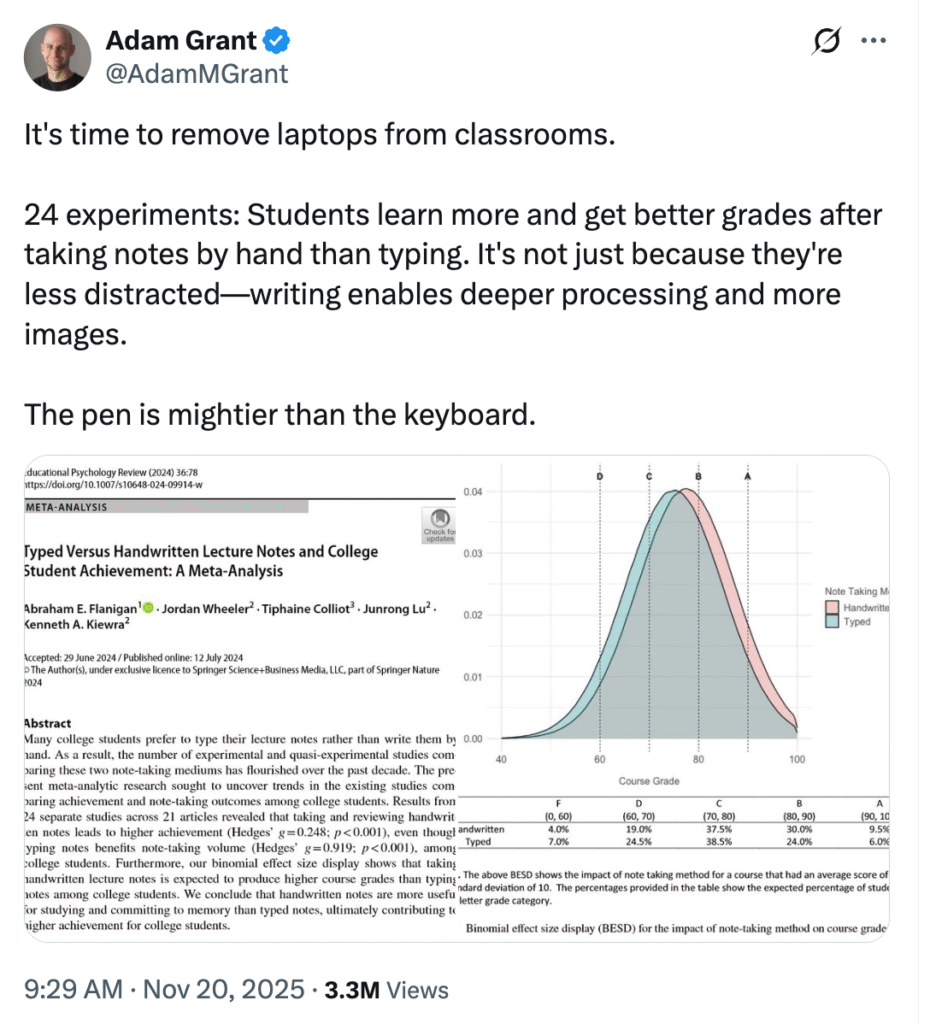
And the comments in response are mainly in favor of that move.
In all honesty, I get it. There are times when I have been frustrated by students’ misuse of technology, as well as by my own kids. There are many pitfalls that both kids and adults face. But I think most solutions to any problems are not in the extremes but somewhere in the grey.
“Removing technology” from schools seems extreme, not because “it is here anyway,” but because of the potential opportunity today and in the future that students will have to leverage and learn using these technologies on their own. Before I sat down to write this email, I watched a video about investing that was timely and relevant to this year, which I wouldn’t have had access to when I was in school. But it is not just the consumption of information, but the ability to “do something with the information” that matters most. Writing this blog post allows me to reflect deeply on my stance and process it, and although it takes time, not everything done quickly is beneficial. I could write these exact words in a journal, but knowing others might read this makes me think more deeply about my position.
As Clive Thompson once shared, “Having an audience can clarify thinking. It’s easy to win an argument inside your head. But when you face a real audience, you have to be truly convincing.”
With all this in mind, I wanted to consider a couple of things.
First of all, a question we all need to consider is, what is the purpose of school?
Is it to become a great learner, or to become good at school? They are not always the same thing.
Many would say that taking technology is not helpful to students because we already live in a world where technology is everywhere.
If you share the sentiment that we should take technology away from students via a social media account or website, are you advocating that students lose the opportunity to share their voices in the way you currently leverage it?
Is leveraging technology something they will intuitively understand, or is it something we can guide and teach?
My argument is not only that things currently exist, but also that they have a potential upside and an opportunity we may not be teaching students to leverage.
I have grown exponentially, knowing that anyone can read this blog post, which makes me consider different viewpoints.
I once heard a quote that said, “There are no solutions, only tradeoffs.”
I get that taking all technology from students would help with many things now, but what is the tradeoff in the future? It is still something I am wrestling with, especially considering the first point of this email.
Secondly, “learning” and “grades” are not necessarily the same thing. Many students who do well at school do not necessarily know how to learn, but are good at playing the game of school.
In “The Innovator’s Mindset,” I shared a valedictorian speech from Erica Goldson, and much of what she said in her 2010 speech resonates today:
This is a portion of that speech:
I am graduating.
I should look at this as a positive experience, especially being at the top of my class. However, in retrospect, I cannot say that I am any more intelligent than my peers. I can attest that I am only the best at doing what I am told and working the system.
Yet, here I stand, and I am supposed to be proud that I have completed this period of indoctrination.
I will leave in the fall to go on to the next phase expected of me, in order to receive a paper document that certifies that I am capable of work.
But I contest that I am a human being, a thinker, an adventurer—not a worker. A worker is someone who is trapped within repetition, a slave of the system set up before him. But now, I have successfully shown that I was the best slave. I did what I was told to the extreme.
While others sat in class and doodled to later become great artists, I sat in class to take notes and become a great test taker.
While others would come to class without their homework done because they were reading about an interest of theirs, I never missed an assignment.
While others were creating music and writing lyrics, I decided to do extra credit, even though I never needed it.
So, I wonder, why did I even want this position? Sure, I earned it, but what will come of it? When I leave educational institutionalism, will I be successful or forever lost?
I have no clue about what I want to do with my life; I have no interests because I saw every subject of study as work, and I excelled at every subject just for the purpose of excelling, not learning.
And quite frankly, now I’m scared.
Some of the brightest students in schools today struggle academically. They might not excel at what they are being measured at, but do we help them find their gifts, or try to shape them to be like everyone else?
When students walk out of school, we don’t need them to be all good at the same thing, but we need to ensure they know they are good at something.
Of course, you have to still work within the constraints of what is being asked in schools, but as I have shared before,
Finally,
Also, for your consideration, here is a post I wrote in 2015 titled, “Taking Notes vs. Taking a Picture of Notes; Which Wins?”
I thought of it when Grant shared in his post that “students learn more and get better grades,” because those ideas aren’t necessarily the same.
In it, the post I share states that although research shows that writing notes helps you retain information better, is “retention” the goal of school?
So one is easier and much less time-consuming, and one seems to improve the ability to “retain” information and be able to share it back. So which one is better for learning?
How about neither?
The ability to simply obtain information and recite it back is not necessarily learning as much as it is regurgitation. I might better be able to retain the facts shared, but it doesn’t mean I understand them. On the other hand, if I am taking a picture, putting it in my camera roll, and doing nothing with that information, then really, what good is that?
What is important here is how you make your own connections for deep learning. Taking a picture is obviously much less time-consuming (why would not just give the information over in the first place?) than writing notes, so with the extra time, the ability to do something with the information is where the powerful opportunities for learning happen. For example, taking this picture and writing a blog post on it will help me more than simply retweeting the picture in the first place. When I speak, I try to challenge people to create something with the information I have shared, whether it is writing a blog post, reflection, podcast, video, or any other type of media. If they really want to process what I have shared, they will need to make their own connections, not the connections I have made for them.
Writing this post is forcing me to wrestle with the ideas shared in Grant’s post, and weirdly enough, making my own connections will help me to remember the crux of his argument.
Someone once said to me that although we live in an “Information Age,” it does not mean we live in an age of wisdom. A favorite analogy to explain this is that knowledge is knowing a tomato is a fruit, and wisdom is knowing not to put it in a fruit salad.
Access to information does not equal intelligence.
Wisdom is something to be developed. Having access to all the information in the world does not make anyone smarter. But leveraging different ways to make your own connections could. None of my “notes” in high school have ever had the impact that writing in this blog has on not only my growth, but also my opportunity.
It would be hypocritical of me to advocate against students using something that I have benefited so greatly from.
To clarify my stance, I do not believe the answer is “Laptops and phones all the time!”
My focus is on how we get students to engage in more in-depth learning with and without these technologies. We need both the foundational and aspirational. The world has always changed, but the rate only continues to increase. None of us can predict the future of education, but I can tell you that no matter what comes my way, I will figure it out. That is what we need to instill in our own kids.
The answer to all of this is definitely complicated, but it is not on one side or the other; it is somewhere in the middle.
The ability to learn, no matter what comes our way, is more crucial than ever. It helps guide students to see possibilities in a future full of uncertainty.
That should be the goal of education today and in the future.
