A certainty in our world is that both you and I are going to make mistakes: the question is whether we will own them and move forward, or pretend they didn’t happen in the first place.
Recently, Allyson Apsey wrote a post for my newsletter titled “3 Things School Leaders Can Do When the Plan Meets Reality,” and, while preparing to schedule it, I read what Allyson wrote, shared an intro and an outro, and then scheduled it for publication. One of my big takeaways from what Allyson shared was her reminder that leadership, like learning, is a messy process.
It reminded me of this Demetri Martin image that I adapted by simply changing the word “success” to “learning” since it is a similar process.

So I did a search for the image, and it led me to a post I wrote in June of 2017, titled “Recognize, Rectify, Move Forward,” shared below, when I discuss a time I could have interacted better in a session I was leading, owned my failure, and because of that, the person I was working with was way more open to the conversation we were having.
I totally forgot about this post, and although it is a bit embarrassing, you can see remnants of “Forward, Together” in what I wrote, as well as the first principle of “Point At Yourself First.” In a podcast that I recorded about re-reading that post, I shared the following:
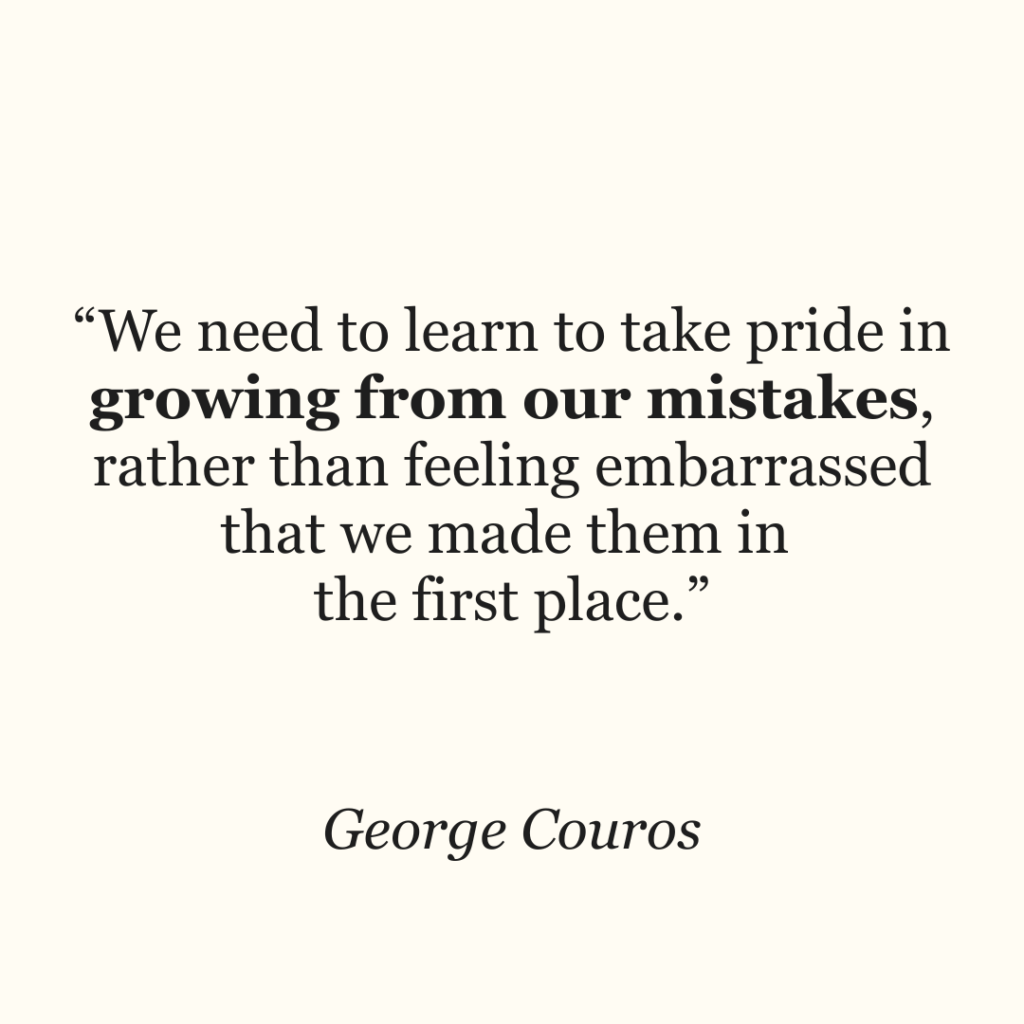
We need to learn to take pride in growing from our mistakes, rather than feeling embarrassed that we made them in the first place.
So, before I share that post with you below, there is one lesson I learned that has helped me own my mistakes before anyone else can, and I think it is crucial to leadership. My mentor, Kelly Wilkins, who was my principal as a teacher and my Deputy Superintendent when I was principal, once said to me, “I like surprises, but not bad ones.”
As she built on that idea, she told me that it is important to note that there are days we can be better, and if you are ever concerned that a conversation with a staff or community member went into a less-than-ideal direction, give me a call as a heads-up, in case it would be brought to her attention. That way, she was always prepared.
I hate getting into trouble, so whenever I didn’t feel great about a conversation, I would give her a quick call and share the details. 99% of the time, nothing happened out of it, and 100% of the time I did not get in trouble with Kelly. On the odd occasion she did receive a call, she was ready to go and supported me as best she could. That didn’t mean always being on my side in the “I was right, they were wrong” sense, but rather providing the best advice to rectify the situation and move forward.
Do you know how valuable that type of leadership is in any field? To know that you can call your boss when you might not have been your best, and never be made to feel worse for owning your mistake. Obviously, I am not talking about egregious mistakes, but whenever you are trying to move things forward, you will ruffle some feathers, and there will be discomfort. But you might not always handle that discomfort in the best way possible. As a principal, I used to tell students that we can come back from mistakes as long as they owned them. Kelly obviously inspired that in me, and it made it so much easier to figure things out when stuff got messy.
I wrote the following in “Forward, Together”:
When you share your past mistakes, your growth process, and a willingness to learn, it can inspire confidence in others to do the same. Remember: You can’t make people change, but you can create an environment where change is more likely to happen. That environment is more likely to be created if someone can say to themselves, “If they can get better, then maybe, so can I.”
Although the post below was not included in the book, you will see that the philosophy was already there, inspired by great leaders who instilled confidence not by always doing things right, but by knowing you can get better when things go wrong.
Check it out!
Recognize, Rectify, Move Forward
(Originally written in 2017)
I try to always find a line between pushing participants in my sessions to learn and not pushing them off a ledge. I want them to feel challenged, not defeated. It is a tough line, and sometimes I do well, and sometimes I struggle.
At a recent conference, I was challenging a participant, and we were both very passionate about our beliefs and ideas about how we could help students. We had to end the session due to time, but I will tell you, it became heated, in what I believed was a good way.
Later at the conference, she attended another of my sessions. This was a huge win for me as I knew she was very interested in what I was sharing. Again, we got into it. As she was speaking, I passionately jumped in and shared my thoughts, to which she said, “Can you actually let me share my thoughts without cutting me off?”
Immediately I said, “You are right…I totally cut you off, and I apologize. My bad. Please continue to share.”
You see, I did not cut her off to be rude. I cut her off because I was passionate, but that passion made me rude to her. When she made me aware, I apologized, and we moved on.
She and I later sat down for lunch, and I apologized again. What I noticed is that her thoughts on my subject had changed. My belief was not because I changed her mind, but that she saw that I am in the same pursuit as her: to do what I can to help students. Yet, I am not infallible. I make mistakes in my pursuit of growth, but I try my best to recognize them, rectify them, and then move forward. She saw that, and our conversations were much different after.
When I am brought into a conference and referred to as an “expert” on anything, I feel uncomfortable. If you called me a passionate learner, I would be honored. I feel the people that we see as “experts” on anything know that in whatever area they are deemed with that distinction, they have so much to learn, and “expert” is a fleeting title.
In leadership and learning, it is necessary to own our mistakes and show that learning is a messy process with ups and downs. As many people have shared, this image by Demetri Martin is about what “success” looks like, but replace the word “success” with “learning,” and is it any different?
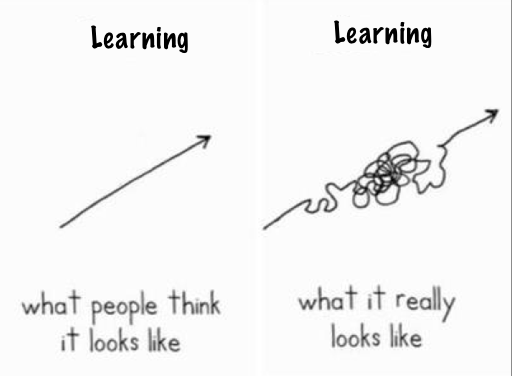
Just pay attention to the final direction of both arrows; they both move upward and onward.
When we realize that we are all just learning, acknowledging those “falls” more quickly can help us get back on the path we need to go.
If your school or conference is working through questions of trust, culture, and how to move “Forward, Together,” you can learn more about my speaking here.
