In June of 2017, I wrote a post titled “You are not a number,” and I wanted to reshare it here today for a few reasons.
Firstly, I am preparing to keynote the Texas Assessment Conference in the Austin, Texas, area, and I will emphasize three points with the group.
They are the following:
- How do we innovate within the constraints of standardized testing (Innovate Inside the Box) to develop great learners who will be great on tests, rather than great test-takers who do not necessarily become great learners?
- How do we build community around a new way of thinking with assessment, as many people default to what they experienced in school as “best practice” since they know no other experience? Community is not about “buy-in” but building ownership through the process (Forward, Together)
- Why is it important to shift from “Data-Driven” thinking to a “Learner-Driven, Evidence-Informed” approach for teaching and learning? (Innovate Inside the Box)
I wanted to expand on the last point a bit before I reshare the June 2017 post with you.
“Learner-Driven, Evidence-Informed” practice does not mean grades aren’t important. I am saying that the learner is more important than the grade.
There is a difference.
I have often shared that there is a difference between the term “the smartest kids” and the “top academic students.” Some of the most gifted students in our schools do not do well academically. Not because they aren’t brilliant, but because they may struggle with what we are measuring. I often lost “points” as a student for talking too much, and now I speak for a living.

The other point that I think is very essential to consider is that schools are still measured in many ways by standardized tests. Whether you agree with that or not, it is a current reality for many schools that they have to pay attention to. “Learner-Driven, Evidence-Informed” practice is not about ignoring grades, but to focus first on students so we can also improve academic outcomes.
The idea behind “Innovate Inside the Box” is that there will always be constraints in education (monetary constraints, standardized testing, etc.), and although we need to continue to advocate for and improve the school experience for everyone, the kids right now need the best experience possible.
And here is a simple “Learner-Driven, Evidence-Informed” practice that would have improved my grades, which I think about all the time.
As a kid, I loved Sports Illustrated and would often rush to the library to get the latest issue and go straight to the back to read Rick Reilly’s column. It was often a sports story with an emotional connection. No writer has influenced me more than him, and I do my best to learn from his style and apply it to the education setting.
In fact, when I wrote the first few chapters of “The Innovator’s Mindset” and shared them with a publisher, they said it needed to be more “academic,” which was never my writing style. I was crushed, but I held to writing the book that I would want to read. Years later, that same publisher expressed regret that they hadn’t moved forward with my style once they knew how many copies had been sold. I didn’t write a “better book” than anyone else; I wrote a book in a style that wasn’t really present at the time. Many people would never read my style of book, but, luckily for me, many others would.
Yet, as a student, I was never allowed to bring those magazines in because they weren’t “real reading.” I did okay in English class, but I never really developed a love of writing until I was in my 30s. The irony of my writing style at the time was that it included too much “personal narrative,” and now, in an age of AI, people crave authenticity more than ever, especially as too many articles seem the same. Was the goal of my curriculum at the time to become a better writer, or to become a Canadian Shakespeare?
“A rose by any other name would smell as sweet, eh?”
And with that, I wanted to share the rest of that June 2017 post below, with some corrections to the original since Grammarly has significantly improved my writing over the years!
(If you are interested in reading more after the post, I encourage you to check out “Innovate Inside the Box: Empowering Learners Through UDL and the Innovator’s Mindset,” co-authored with Dr. Katie Novak, which has an entire chapter on “Learner-Driven, Evidence-Informed” practice.)
You Are Not A Number
(Originally Posted June 2017)
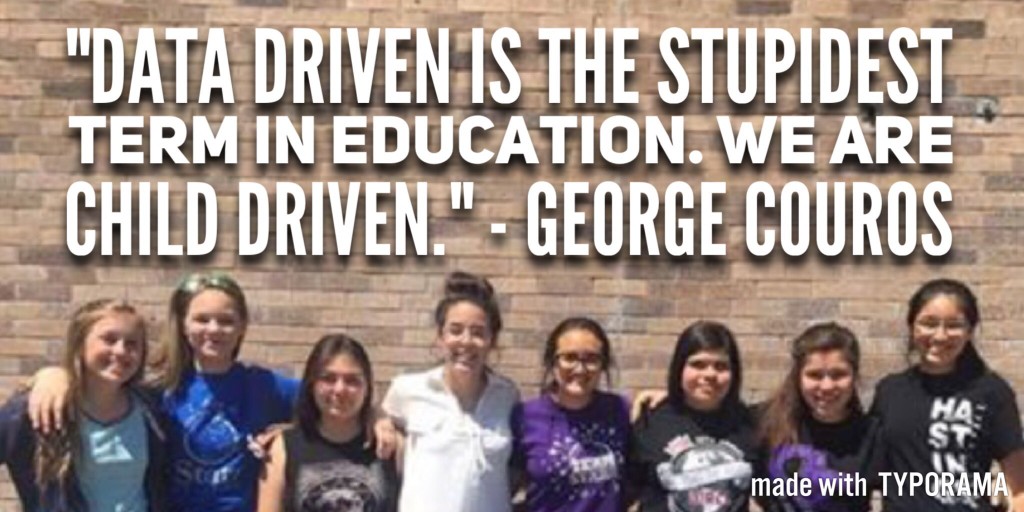
I recently made the above statement (in the image) at a conference in Nebraska after asking teachers, “Have you heard of the term ‘data-driven’?” to which they responded with audible groans.
This isn’t the first time I have made this statement, and it will not be the last.
Still, some people are bothered by the fact that I do not like the term.
Here are some of the arguments with my rebuttals…
Argument 1: “We always have to remember that there is a ‘face’ behind those numbers.”
No… you have to remember that the “face” is in the front and is the most important. You can use numbers, but do not be “driven” by them. Do not forget our students are human beings with unique needs, characteristics, qualities, and should be treated accordingly.
Argument 2 – “Yes, we are not ‘data-driven,’ but it should inform our practice.”
I struggle not only with the term “data-driven” but also with the word “data” itself, because we have made the term “data” all about numbers in education.
I believe we need to be “evidence-informed“.
When you see your students perform an amazing musical, or create an incredible work of art, is that evidence of learning, or do you want to reduce what they have done to a letter or number? As soon as you do that, you jeopardize the “artist,” leading to a loss of love for the art.
Here is my bottom line… (Very “Stone Cold” of me to write this.)
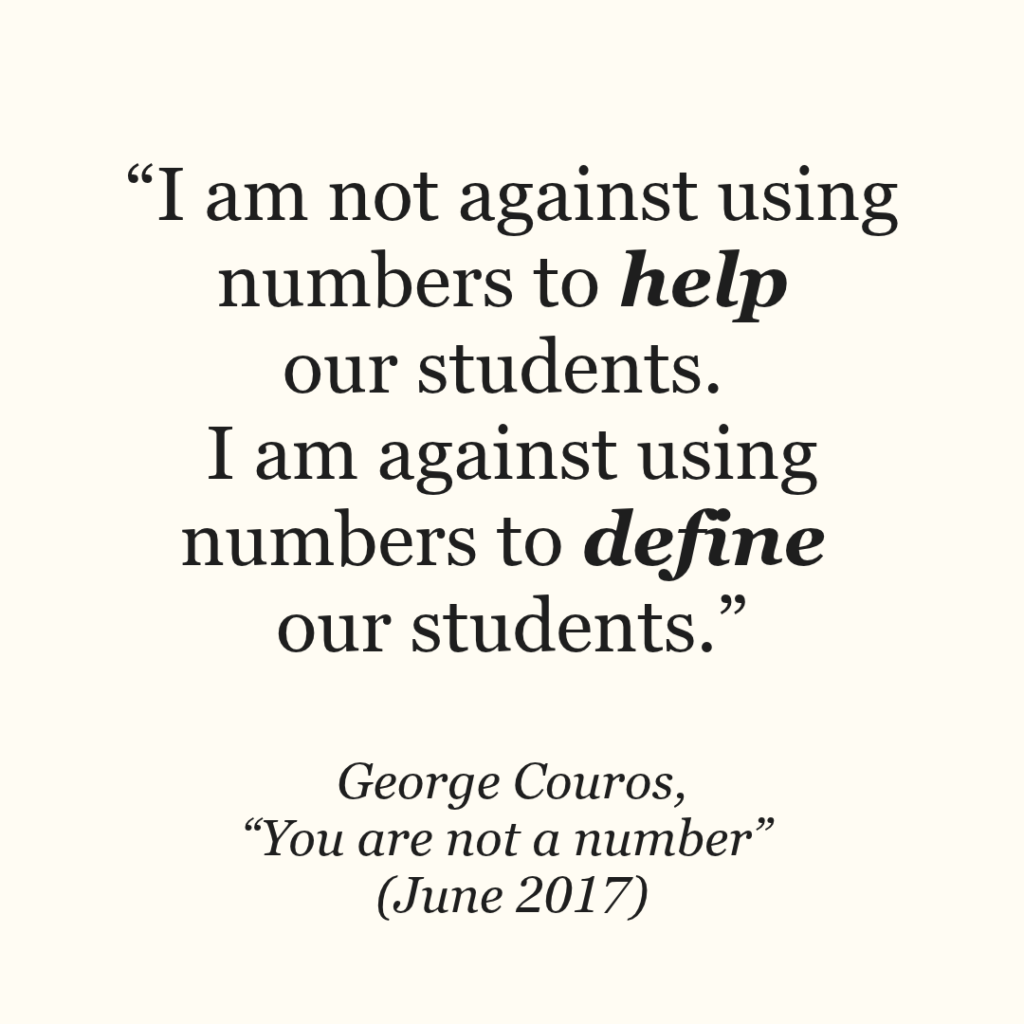
I am not against using “numbers” to help our students. I am against using “numbers” to define our students.
Consider the following (note from 2026 George; I think the below has changed significantly since 2017!):
How often do you go to a conference where they are
focusing on how to get better grades from our students?
vs.
How often do you go to a conference and they focus on
seeing the genius and finding the strengths of each student you serve?
If you wanted to, you could start focusing on the latter right now and make it happen immediately.
I remember attending large classes at universities, not caring about the content, and knowing the professor did not care about me as an individual. They would show up, teach, leave. I was a number on a piece of paper outside an office, with another number attached to it indicating how smart I was in that subject.
This is a true story, but I am lucky to be a teacher because I needed a calculus credit to teach elementary education.
I attended the course with 500 other students. I didn’t understand any of the lectures, struggled with all the content, and eventually just “checked out”.
At the end of the semester, I found my “number” (identification) attached to another “number” (my grade). That number happened to be 40%. Luckily, so many others had that number or lower, that with the “curve”, my 40% became a 60%, and I passed the course.
Without that curve, I would not have received my teaching degree.
Here are a few other numbers from that course that matter.
Times talked to the professor = 0
Times professor referred to me by my name = 0
Percentage chance that they knew my name in the first place = Less than 5%
(“Never say never.” Justin Bieber)
(Another note from 2026 George; I sure did like Justin Bieber back then and still love his music today!)
Just from the story above, I know that I am going to get some “that’s the real world“ comments.
Here is what I hope the real world is about.
If I struggle, I can be comfortable asking for help.
I am valued as an individual.
If I work with you, you know my name (at least),
and I know yours.
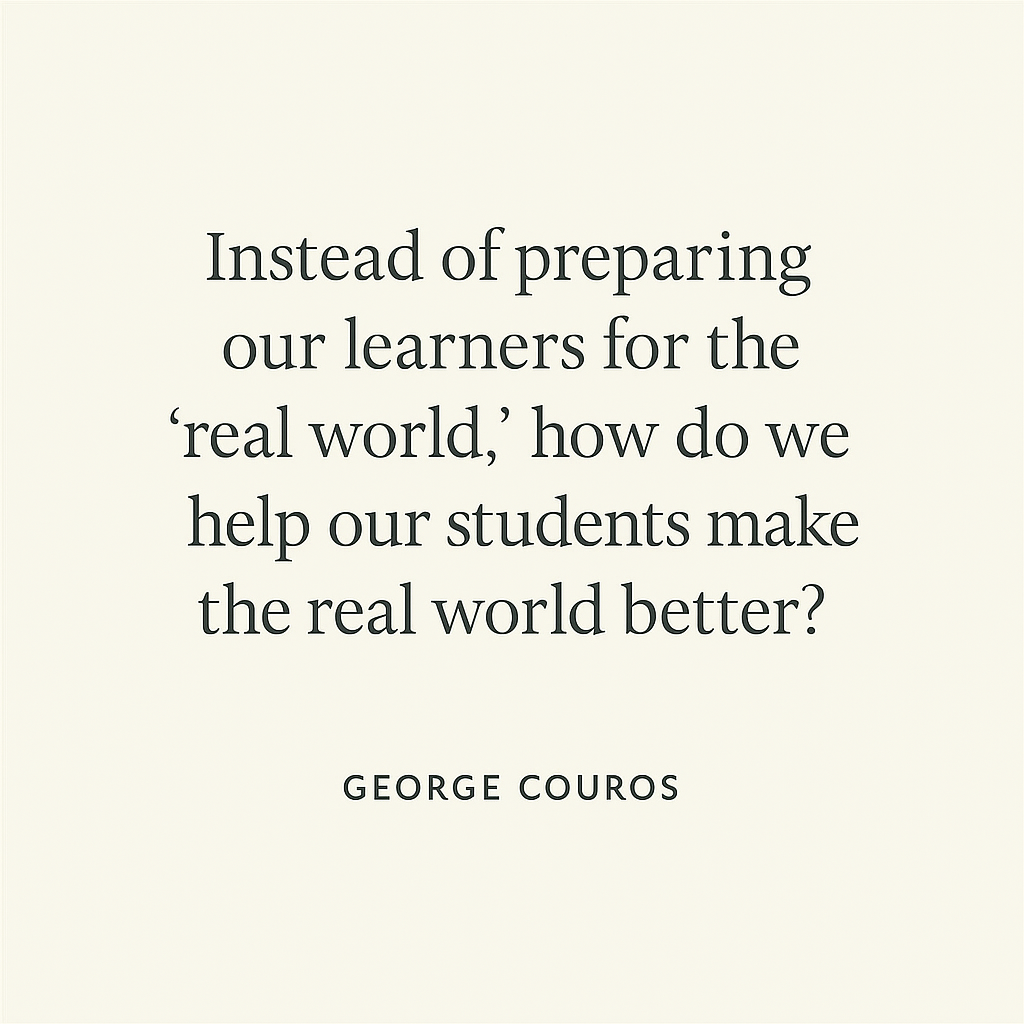
These are all characteristics of being “learner-driven“, not “data-driven”. If the “real world” is crappy, I don’t want our students to adjust to it; I want them to make it better.
In business, without the customer, there is no business.
In education, without the students, there are no schools.
#dontforgetthat
Let’s not take the most human profession in existence and reduce it to letters and numbers.
Our kids need more from us.
