“The kids are always watching, and they learn more from our actions than our words. Always.”
This is one of the reminders I provide in my “Forward, Together” keynote in a story I share about how my oldest daughter has been reading my newsletter and blogs for the past couple of years (she is 10) without my knowledge.
It has made me really think not only about what I post but also about how I interact with others. When my kids are watching, it makes me want to be better.
And when we intentionally invite students into spaces with adults, especially when the adults are talking about them, I believe that can have a tremendously positive impact.
More on that in a second…
Who is telling the story of our schools, and why does it matter?
I am currently working with a principal on ideas to help build ownership amongst students and community over their school. A simple suggestion I provided her is that her principal communication should be led by her students. She immediately ran with it, and not only are the students excited, but you can feel she is as well.
There are some big benefits to this process, two of them being 1) having students do this will eventually lead to less work for you (isn’t that awesome), and 2) they (the students) will have more ownership over the entirety of the school, leading to deeper learning.
Less time working and deeper learning for students.
Great outcomes!
The other part of this is that families will probably care more about that communication because it is coming from their own kids. I have often said that I would rather see the imperfections of my kids than the “perfection” of adults. And having students become the voice is a great way to build trust in the community that your focus is on elevating students.
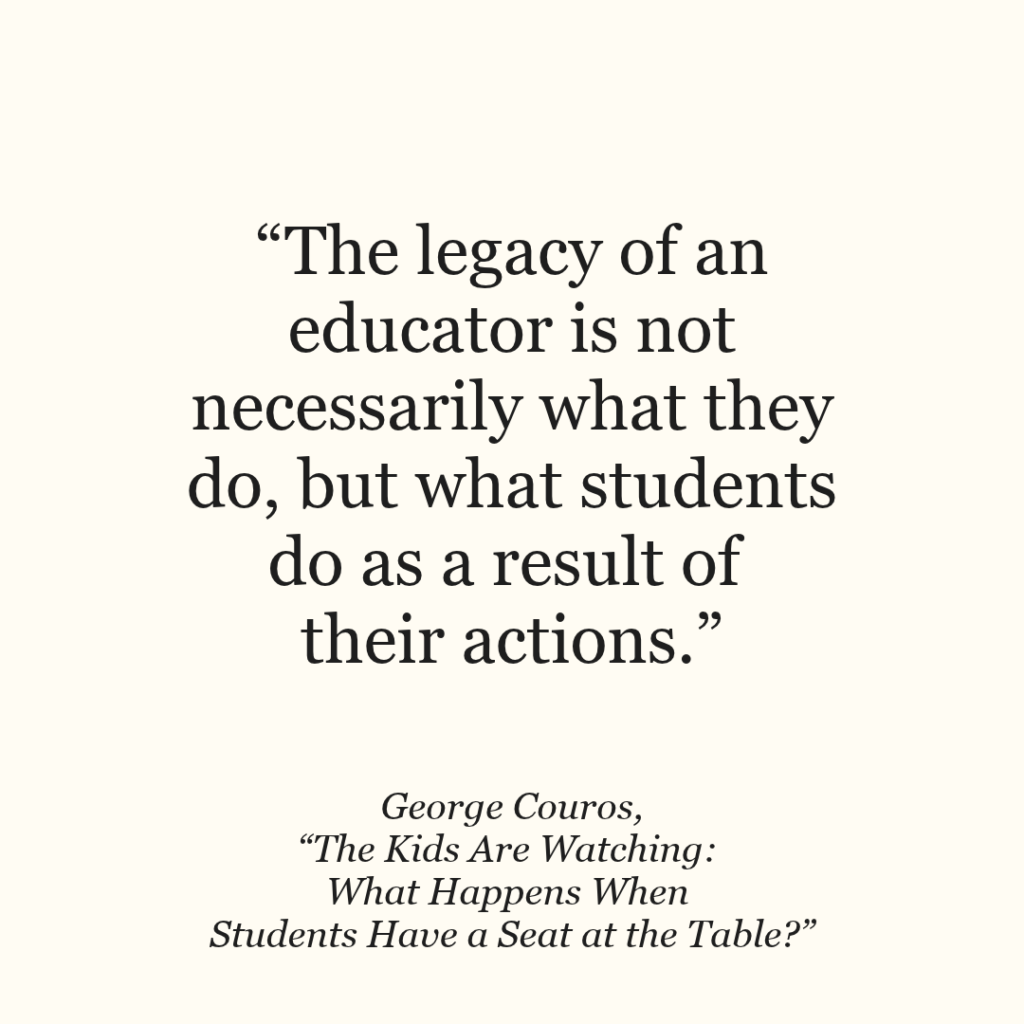
The legacy of an educator is not necessarily what they do, but what students do as a result of their actions. Elevating student voice is not only a way to build excitement in your community but also to build trust.
This can also feel risky.
But there can sometimes be nervousness in empowering students. I have talked about the idea of empowerment over the years, and I often think that part of “empowering” others is handing over power you may have to someone else.
You are handing over the reins of leadership, even if temporarily, to follow someone else’s lead.
And when that happens, it can create something better now, and in their future. If we are “developing the leaders of tomorrow,” the best way to ensure those leaders succeed is by providing leadership opportunities today.
Superintendent Dr. Jordan Cox has done a great job of empowering others in Commack Schools (Long Island, NY), and I asked him how he has built that culture in his community, especially as schools feel under more scrutiny than ever.
He shared the following with me for “Forward, Together,” and it really resonated:
I have often talked about
“The only way to inspire people to go above and beyond, especially during contentious times or when introducing bold, new ideas, is to lead with genuine leadership. That means treating people with dignity and respect.
When you do that, the staff won’t just comply, they’ll innovate. They’ll take risks, step out of their comfort zones, and pour their energy into what’s best for children. This only happens when leadership is rooted in trust, respect, and a relentless focus on what’s best for children. Leading through change requires not just making the right decisions for children, but also being fully present to support the people who serve them every day, alongside our community.”
Dr. Jordan Cox, Superintendent of Commack Schools
And what is one of the best ways to do what is best for our students? Have them present in the conversations that matter most to them.
Commack Schools recently shared a great example of that.
Who do students listen to?
In the past, I have worked with several school districts on the topic of “Digital Leadership” and really empowering students to be thoughtful of how they can use technology in purposeful ways. In the places where this has been most successful, it wasn’t just me showing up and sharing ideas. There was a process of working with a small group of students, who then collaborated with other students to move these ideas forward. I might know a few things about technology, but students are more likely to listen to their peers on this than some guy born in the 1900s.
But when we set up those student leadership teams, staff joined them as well and didn’t tell them what to do. They listened. And they were impacted by hearing things from the students they didn’t know. They also started talking about how they wanted to be better because of the example the students set. And when I worked with communities that took that approach, the process was much more successful.
It is not just about “doing the thing” but about being intentional not only in including students but also in having them lead and work with each other.
That is why I loved this video I recently saw from Commack Schools that was both amazing and unsurprising if you know the district at all.
Shared on their main Instagram page (probably elsewhere as well, just where I saw it), they had “Student Ex-Officio board member Cassidy Gill” reporting on what her peers shared with the board and what the adults discussed, to her peers and the community’s families.
Take a watch below:
View this post on Instagram
I won’t get into what she said (you can listen to her directly), but I just thought that this was such a good idea for many reasons.
When I first read the caption, I will admit that I had not heard of the term “student ex-officio board member.”
Upon finding the definition here, it is “a student representative who sits on a governing board—most commonly a school board or board of education—to provide student perspectives and act as a liaison between students and board leadership.”
It is also an initiative that started in 2024 from the state of New York. That is great!
Now, I don’t think Commack Schools is the first district to have a “student ex-officio board member” at its board meetings or to report it back to the community via social media.
In fact, I have seen student board members as an initiative in Ontario, Canada, for as long as I can remember, and I know more places are focusing on bringing students in and leading these conversations.
But typically, when I have seen “highlights” from board meetings on social media, they have often looked like an old episode of Jerry Springer.
Now, I get “algorithms,” and all that, and what you pay attention to often shows up in your feed. I might have watched a car crash once or twice in my life, so that might be partly my fault.
But when you hear “here are some things that happened at last night’s board meeting” on social media recently, don’t pretend you might not get a little nervous about what you are about to see.
The thing I kept thinking about while watching Cassidy (seriously, she is awesome) report on what happened at the board meeting in Commack Schools in that video was how the adults (including me) might act when we know the students are watching.
I have been really thoughtful of what I post on social media over the years because, as I have shared before, my posts are like a diary I am leaving to my kids. But when I knew my daughter was watching, I straightened up and thought about it more.
Would the same be true for the majority of adults in a board meeting, especially when they disagree with each other in public? I guarantee you not always, but definitely more often.
One of the main things I discuss in “Forward, Together” is that we don’t have to agree on everything. But when students are part of those conversations, we have an even greater responsibility to model productive disagreement. We aren’t just making decisions about their future; we are showing them how to lead in it.
As I have shared with groups, one of the things I am really emphasizing right now is how we treat each other and our character, especially when we disagree.
I am not trying to get everyone to think like me, or each other, no matter the topic.
My hope is to embody and inspire the following:
We can have disagreements,
but that doesn’t mean we have to have division.
In my work with school boards, superintendents, and educators, I often ask a simple question: Are we modeling the type of leadership we hope to develop in our students? It is one thing to talk about student leadership, but another to create the conditions in which students can actually lead. That is a conversation I hope more school communities continue to have, and I am grateful for places like Commack Schools that are leading the way!
And perhaps when the adults know students are present and watching (and even reporting after), we are more likely to model what we hope to see in our own kids.
And maybe not.
But bringing student voice and representation into the places where decisions about them are made is never a bad idea.
Helping schools build trust, elevate student voice, and move forward together is a central focus of my work with school districts and leadership teams. If you’re looking to bring these conversations to your school community, learn more about my Forward, Together keynote and speaking opportunities.
