There are certain scenes in movies that stick with me long after I see them, not only because they are memorable but also because they bring a sense of calm or peace.
For example, at the end of La La Land (no spoilers!), there is a moment where the main characters say so much to each other without saying a word. It is one of my favorite movies of all time, and it cemented Ryan Gosling as my movie icon. I am sure if we met in person, we would definitely be the best of friends.

Okay, maybe not!
Anyways, a recent movie I really enjoyed (but I am not sure I would recommend) is “The Smashing Machine,” starring Dwayne “The Rock” Johnson, which is a biographical film about UFC fighter Mark Kerr. As an avid sports fan, I walked into this movie knowing nothing about Mark Kerr or this story, and perhaps that is part of why I enjoyed it so much.
But there is one moment in that movie that I cannot get out of my head.
As most sports movies do, there was a montage of the athlete really pushing himself in training, and in a few-second scene, Mark Kerr (played by The Rock), is sitting in a pool of his own sweat after pushing himself way beyond his limits.
The GIF (Surprisingly pronounced YIF, which will settle any debates!) of those two seconds is below:

What stood out to me was that the moment of pure exhaustion resonated with me and brought me a sense of calm.
I will tell you that at 50 years old, I do not just go to the gym. Every day, I push myself as hard as possible, and honestly, I am often in the middle of those workouts, wondering why I am doing that to myself. A regular at the gym saw me at a Starbucks one day, and she said, “You are that guy at the gym who really pushes himself! It is incredible to see!”
That comment was taken as a massive compliment.
But through that push to exhaustion, I somehow find peace.
No matter how bad my morning starts or how off my mental health feels, in those moments of exhaustion, I am focused on nothing but what I am doing at that time. It is a “peace” I find in the chaos of life.
Since I was probably in my 20s, I have done distance running and have run four marathons, numerous half-marathons, and other distance races. Whether I have a race or not, I am constantly training for one. And there are times on a Sunday when I am doing a long run, when I have pushed myself too far and need to call my family to pick me up on a random road, knowing I can’t go another step.
So why would I do this?
I never had any clue, until I heard someone say that many endurance athletes do that type of training as a response to trauma.
Ahhh…That started to make sense.
From a quick Google search, I found this article, “The Correlation Between Trauma and Endurance Sports: Unveiling the Healing Power,” where it shared the following:
“…endurance sports become a conduit, a hidden passage where your emotions find a purposeful outlet. And those endorphins? They’re like a comforting pat on the shoulder from your body, saying, “I’ve got your back.” When you’re in the zone, they flood your system, and dilute away any stress and anxiety.”
That made a lot of sense to me. Many would see it as literally “running from your past,” but for me, it is running toward a better future.
I then read this article that shared the following:
“For some, that healing path involves endurance sports. For others, it may look different. What matters is finding ways to reconnect with the body, regulate the nervous system, and reclaim agency — on their own terms.”
I have lived with depression and anxiety for as long as I can remember. I hate the idea of saying I have “struggled” with these things, because, in my own way, I feel they have made me more empathetic and understanding of others. It is just a part of who I am, and if I only see the negatives, I feel that gives it too much control. As I have shared before, I think you can find strengths in perceived weaknesses, and that is how I choose to see myself and look for in others.
When I saw that scene, my thoughts were not limited to how I feel when I exercise, but also many times in my own work.
You will often hear people say that “we need to find balance” to the point where it becomes cliché, as evidenced by the below meme:
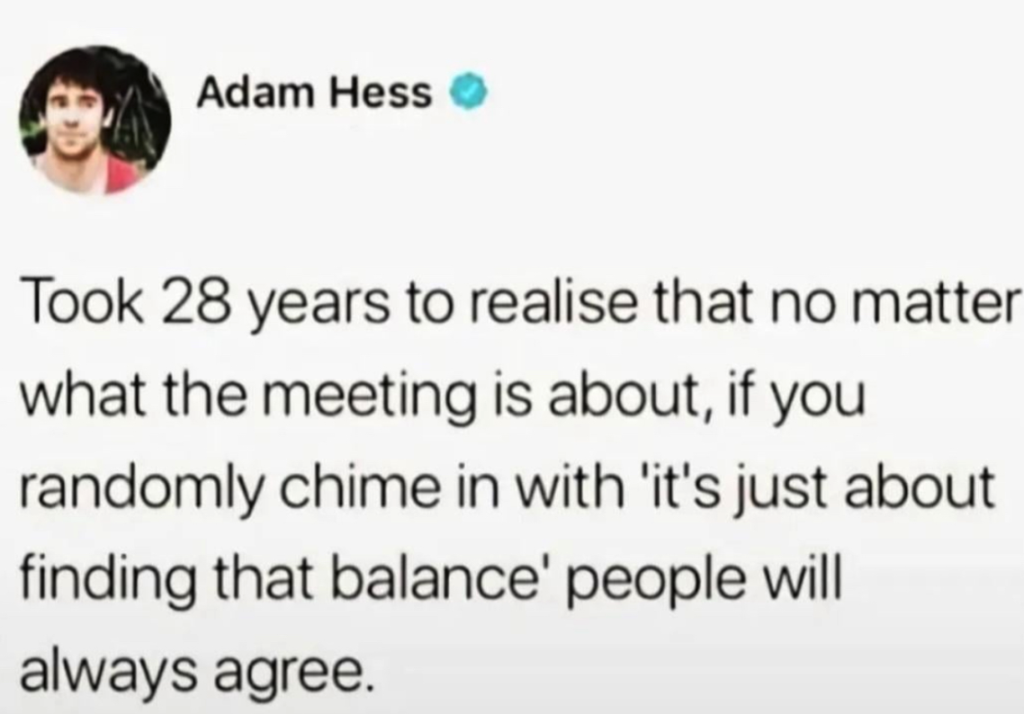
For me, life is less about “balance” and more about “presence and purpose.” That matters much more to me.
And yet, we will get on people for not living the way we want them to. Not necessarily what is best for them, but for our own aspirations.
As a principal, I was not married, had no kids of my own, and I HATED when people said to me, “You don’t have your own kids, so you don’t understand!”

I swore I would never say that to anyone else later in life.
Today, I often talk about my kids, but I share my experience, not push it as the standard for others.
And yet, we are often quick to say, “You shouldn’t stay at school too late! You need to get home!”
But there were times in my life when work was the thing I needed most.
As a principal, I remember spending every Monday-Thursday evening at a Starbucks, writing and creating content about my work, and eventually, that led to many of the opportunities I have today.
But every Friday evening, when most people left the school early, I would stay in the building until probably 10 or 11 PM, not because I was obsessed with work, but because work gave me presence and purpose and ultimately, peace. I didn’t just love my job; I needed that space to bring me calm based on some of the things happening in my life at the time, or prior.
Someone else’s peace might be found going for a walk and being with nature, while I can often find mine listening to Metallica and going for a run.
So instead of judging that person for staying too late, or going home too early, ask yourself if you were ever in that season of life? And if you were, did it help you find peace, or destroy it?
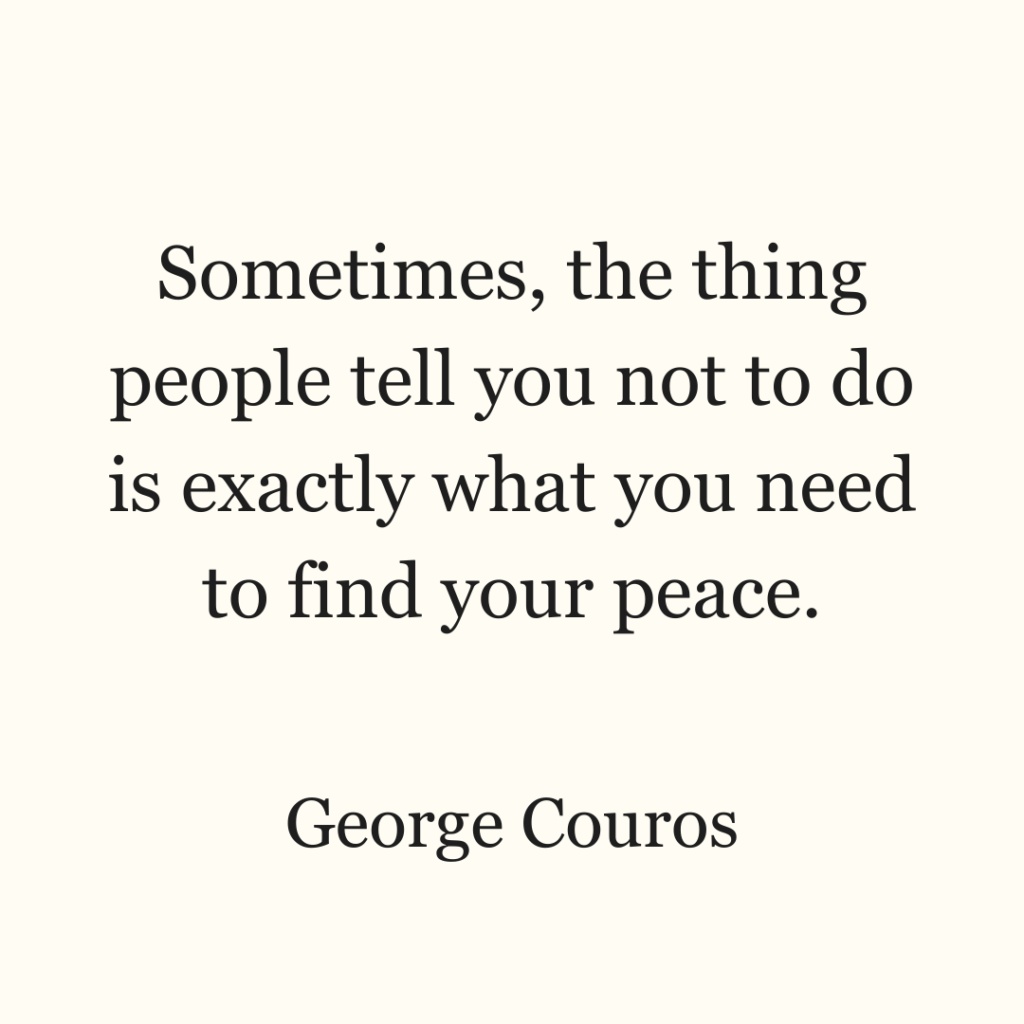
I can share what has worked for me in the past and present, but sometimes the thing people tell you not to do is exactly what you need to find your peace.
Share your experiences, but never assume they should be the standard for someone else.
