When people see me standing at 6’4 and weighing 220 pounds, the first thing they probably do not think is “that guy is a runner!”
But I have been running races off and on for the past 20 years, am currently training for a half marathon, and have even written about the connection between running and learning. I have even been featured in Runner’s World Magazine.

And not “looking like a runner” is one of my favorite things about distance running. Unless you are a professional athlete, runners come in all shapes, sizes, and ages. In fact, in the first marathon I had ever run in my late 20s, I remember being 2 kilometers away from the finish line, and getting a bit overconfident in my abilities. Until a woman, probably in her 80s and over a foot shorter than me, passed me easily and humbled me in a way I needed to be humbled!
Runners rarely look like runners. That is one of the best things about the sport.
This is probably why Jay Shetty’s viral video resonated with me so deeply.
View this post on Instagram
If you watch the video, you notice that every runner has a different reason for running their race. You read words above each runner like, “finding themselves again, doing what they thought they couldn’t, honoring a friend.”
It resonated with me because each time I ran a marathon, I had a different reason for doing so.
The first was to do something I never thought I could do.
The second was to see how far I could push myself.
My third (I didn’t finish) was to qualify for the Boston marathon.
I injured myself in that race and was destroyed, which is why I ran my fourth one 18 years later. To prove to myself that I could do it again, and so my kids would see their dad train for something really hard and finish.
Each race had a different reason(s), and each of them was important.
But if you look at the video even closer, you notice the “words” are not just above the runners.
They sit above the fans on the side and say things like, “supporting a co-worker, cheering on family,” and my favorite, “proud dad.” They all have reasons to be there as well. And here is the beautiful thing about running a marathon, or any distance race.
While people are waiting for the people they love to pass by, they cheer on strangers.
In my last marathon, right when I was getting tired, someone said, “Go, George!” I looked at the person and had no idea who they were. I quickly realized they a) saw I was tired and b) read my first name that was on my bib. That was a new “innovation” in races that was not present the first time I ran—just having someone’s first name on their bib. That “cheer” gave me a jolt of energy I needed more than I could have told you.
And in an earlier TikTok video I shared on my blog, Ali Gallop said, “Think what’s possible if we cheer for complete strangers.”
While people are waiting for people they love to pass them by, they just happen to cheer on others along the way.
And if you took this same video and made it in a school hallway, you could do the same thing. Kids are there for different reasons.
One student might just be trying to get through the day. Another student is trying to get into Harvard. Another is going to be the first in their family to graduate high school. Every reason you can think of, and can’t, is present in those hallways. Each kid running their own marathon.
All have different reasons, and those reasons might change over time.
And it is not just those running their marathons in your school. It is the community that is supporting them.
One story that will stay with me forever is a student who shared with a group of principals that she had struggled her entire time in school. She said the one thing that kept her going was a teacher, who had never taught her a class in his life would say good morning to her every day in the hallway and address her name. He just didn’t need the “bib” to know her name.
And the “strangers” on the side should not be limited to staff. It is hopefully families. As I watched my oldest daughter play her first basketball game at 10 years old, a player on the opposing team did a “Euro-Step” and scored a layup. I cheered for that kid the second loudest after his family, because if I even tried doing that move in slow motion, I would probably end up in the hospital. The amount of work that kid put into that move was unseen by me, but I know that was not a fluke, but hours of unseen practice, as well as support from his family.
One of the reasons I wrote “Forward, Together” was because of this exact focus on local communities. I grew up in a time when if you got into trouble at school, you would also get into trouble at home. It wasn’t that adults hated us, but families and schools knew that if they worked together, they would at least double a child’s chances of success. And that support wasn’t just from schools but also from neighbors and the community.
As much as we have talked about schools developing “Global Citizens,” too much has shifted away from the importance of local communities. That is where everything starts.
Marathons are hard. Excruciating. In fact, I have trained for both marathons and half-marathons, and it feels like the jump from the smaller to the larger one is not twice as hard but at least ten times harder.
But here is the unbelievable statistic shared by Olympian Sarah Wells.
The approximate completion rate across all marathons globally is 95% to 99% of runners who cross the starting line. Basically, if you start the marathon (26.1 miles or 42.2 kms), you are very likely to finish it. Wells shares that it is about collective effort, but maybe, because I am very focused on this idea, there are two reasons the completion rate is so high.
The first is that everyone has a reason for running that race in the first place.
It might change over time, but something is driving them to not only sign up, but also train, and ultimately, finish their race. My reason today is different than it was in the past, and although I don’t look like a runner, being a model for my own kids will drive me more today than qualifying for the Boston Marathon did when I was 30 years old. And at my age, I need more inspiration today than I did then!
The second reason is community.
It is not just those who are there to cheer on the ones they love, but their ability to cheer on others who are running their own race for their own reasons, that they do not know.
And if we understand that everyone has their own drive for why they are doing something, and create the community to support them along their way, the number of people who would find success in their own way would increase dramatically.
Years ago, I challenged this quote:
“Every child needs at least one adult who is irrationally crazy about him or her.” Urie Bronfenbrenner
It wasn’t that I didn’t appreciate the intention. It was the number. One is not enough.
If students spent their entire time in schools and only had “one” adult who felt that way, it would never have the impact of a community that felt that way and cheered on others’ success.
In “Forward, Together” I share the following:
“I have never regretted acknowledging the good I have seen in others, but I have regretted not saying something.”
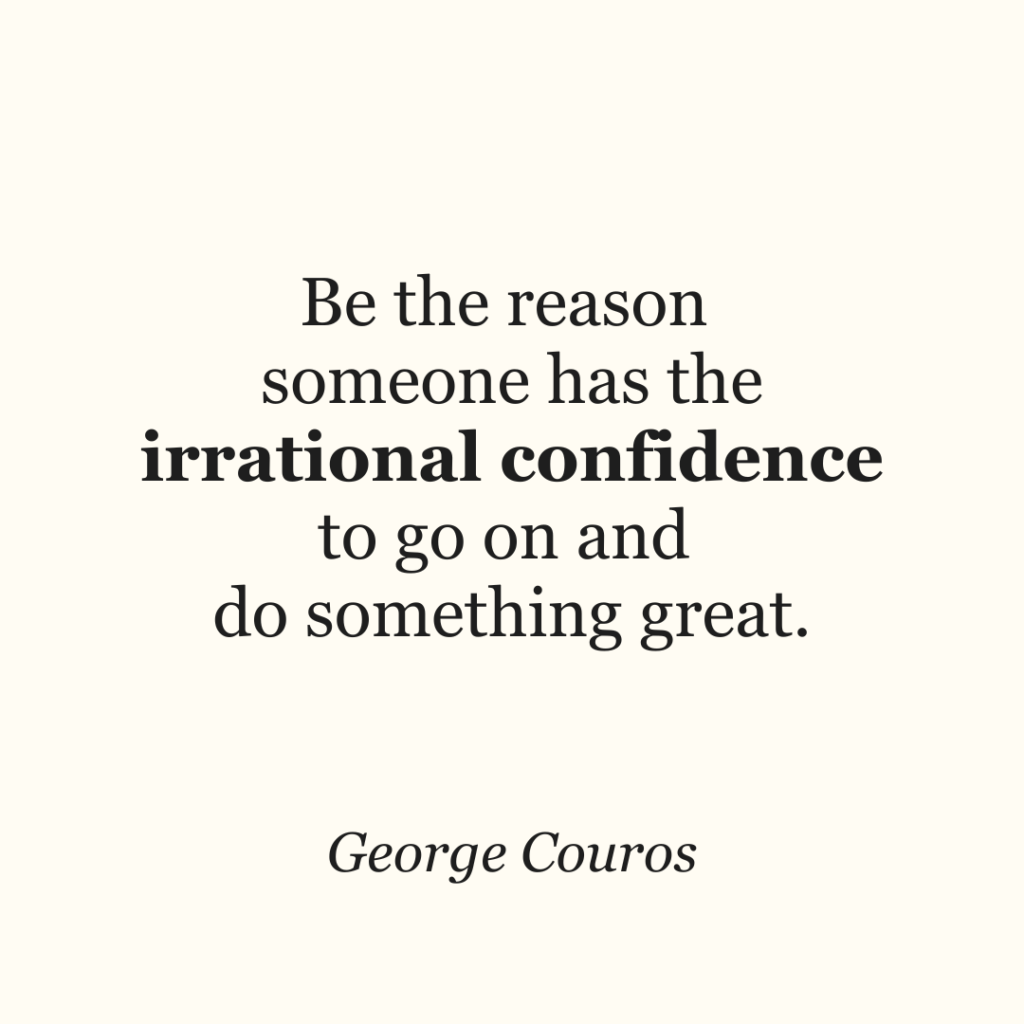
I believe that we need to be the reason someone has the irrational confidence to go on and do something great.
The beauty of this belief is that it can come from strangers.
The fan yelling “Go George!” when I needed it most.
The teacher in the hallway saying good morning to the student they don’t teach.
The community member cheering on a kid’s hard work playing in a sport against their own child.
Every kid needs that community coming together to cheer them on. Imagine the races they could excel in if we embraced that idea.
If your school, district, or event is focused on building community to help all students find and define their own pursuit of success, and you would like to learn more about the “Forward, Together” principles and why they matter, you can learn more about my speaking here.
