One of the strangest things that has happened over the last several years in my own learning is how many paper books I have read.
In the last three years, I have probably read more books than in all the years of my life prior. For whatever reason, the brevity and sometimes lack of depth often shared on social media have pushed me toward more long-form content.
That being said, I still enjoy a lot about social media.
Some of it is hilarious, and it can provide a much-needed break from “thinking,” and I also enjoy connecting with others. But I have also become increasingly frustrated by the absence of nuance in conversations and by clickbait-type “hooks” meant to grab attention.
For example, if you want to lose weight, ultimately you have to be in a “calorie deficit.” Burn more calories than you consume. There are different ways to achieve this, but you will see a fitness account say something like, “Calorie deficits don’t work!” to grab the attention of an audience that is consistently scrolling. Sometimes, the “hook” is a lie, and eventually they get back to how calorie deficits really do work, but often people do not make it past the first sentence and head straight to the comment section, which is perhaps beneficial to the creator but not necessarily to the conversation.
I have also noticed this trend in education, and this Facebook post from Todd Nesloney really captured my attention (speaking of attention!) and said something I was struggling with but had trouble articulating.
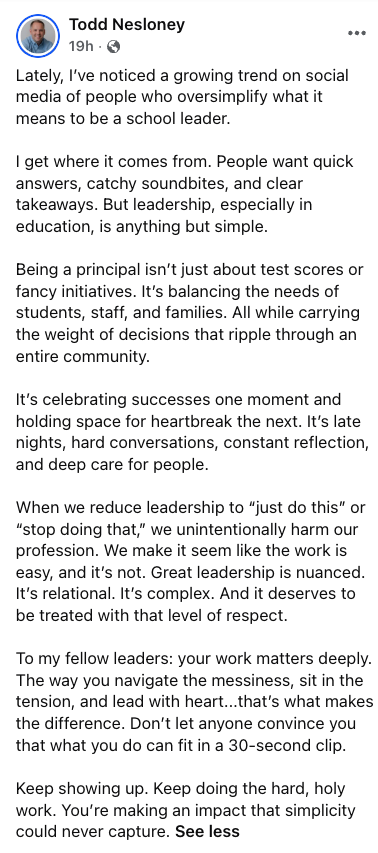
I really appreciated what Todd wrote, and in some ways, it validated the fact that I have kept this blog going for the past 15 years.
Blogging, for many, seems like an archaic practice (like using Yahoo to search, or, if you are really old like me, Ask Jeeves… There’s a blast from the past!), but I write more for my own learning than for anyone else’s. Writing has been cathartic for me, helping me process my own thoughts while trying to understand different perspectives.
This quote from Todd especially resonated:
“Great leadership is nuanced. It’s relational. It’s complex. And it deserves to be treated with that level of respect.”
Todd Nesloney
I will give you an example in my own work.
As a teacher, I did not have a great experience with PLCs. They seemed like a waste of time, and I didn’t really get much out of the process. But as I entered administration, I began to realize that my experience with PLCs was less about the process and more about how they were implemented. It could have been something an administrator saw at a conference and thought, “if it worked for that school, then it could work for ours!” without much thought about how to introduce it to a school community or ensure it was implemented in a way that was beneficial to staff.
Simply put, because it didn’t work for me doesn’t mean it wasn’t helpful to others. Some would say that it was the best thing that happened to their school, and some would say it is the worst.
Can both be true?
Probably.
As Todd shares, it is “nuanced, relational, and complex.” There are many reasons why something works for one person or community but not for others. It is not limited to PLCs; it applies to many aspects of education.
We can’t expect kids to be critical thinkers while we sometimes search for surface-level solutions to complex problems.
For many, the thought is that we don’t necessarily have the time, but sometimes (and I include myself in this), we don’t have the attention.
But to solve meaningful problems, deep attention and focus are needed.
As I share in my talks, I am just sharing ideas, but YOU have to figure out the solutions because no one knows your community and context better than you do.
And maybe that is why I like writing in this blog. It gives me that space to dig deeper into something and try to understand different perspectives.
In a time of brevity, I am craving nuance.
In a world that seems divided, I am craving connection.
In a time where quick fixes are embraced, I am craving finding long-term solutions that may be more complicated.
We live in an “attention economy,” and I am doing my best to spend my attention on areas that will make me better.
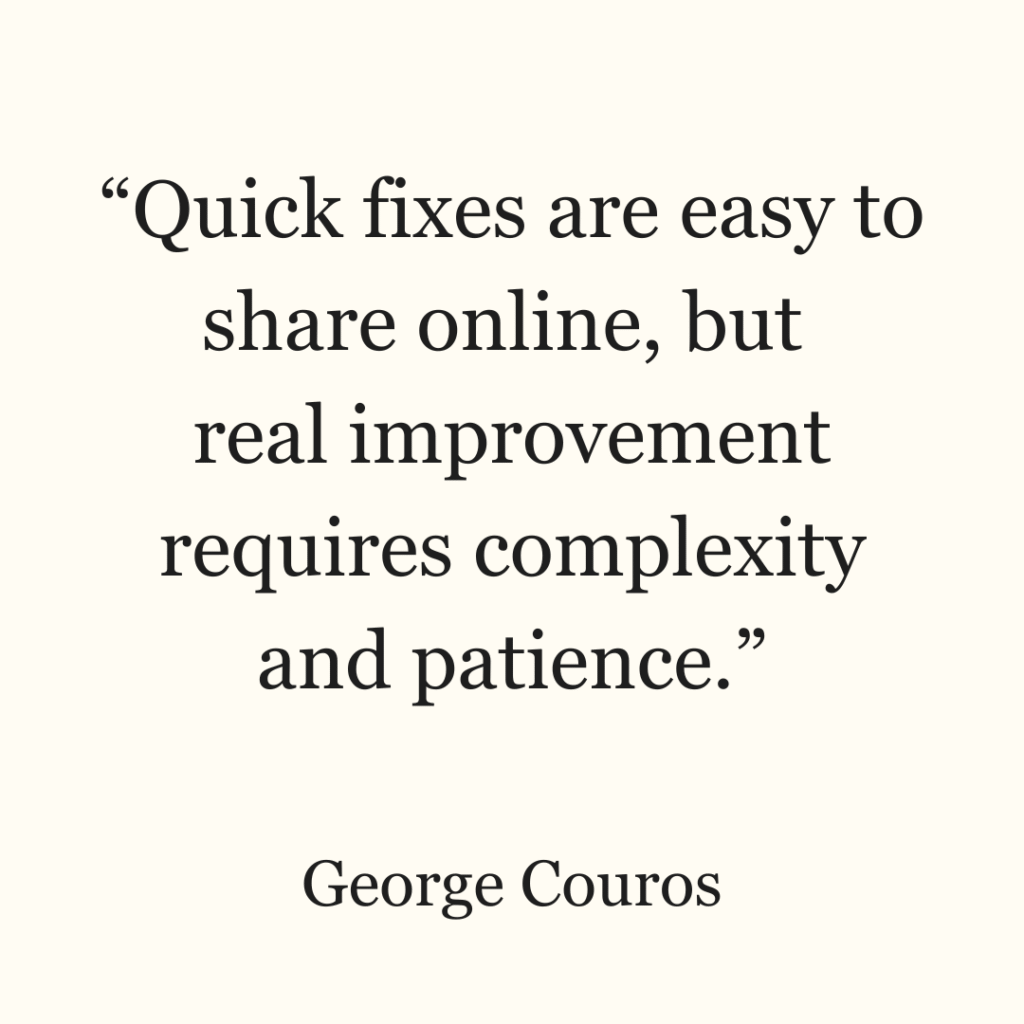
Quick fixes are easy to share online, but real improvement requires complexity and patience.
Seeking knowledge in pursuit of wisdom, being innately curious, and focusing on presence with myself and others, is a larger investment today that will pay greater dividends in the future.
As Todd shared, “nuanced, relational, and complex.” Three words that can carry a lot of weight in our learning communities.
