The whole house can fall apart with one bad 30-second moment.
Two examples I want to share with you in and out of education.
When we first moved to Florida, I had contacted a realtor on Instagram who we were interested in working with to get some information. We had chatted back and forth, and once we had decided to finally make this gigantic leap for our family, I asked if we could chat on the phone.
I was provided a number, and when the realtor answered, I realized all of a sudden that I wasn’t talking to the person, but the person who was “running their account” for the person. I was sharing details about our move with someone who was pretending to be someone else. It felt like I was on “Catfish: Realtor Edition,” and all of a sudden, trust evaporated.
Now I get people are busy, and so many do not run their own social media accounts (I do because I do not feel comfortable with someone being my “voice. Unless I said something dumb. That was my brother, Alec.).

The easy, proactive fix for this is to just share in the conversation that you are representing that person, etc. It was a weird moment, and all of a sudden I was leery of everything that was said.
Stephen M. R. Covey shares the following, and it makes a lot of sense:
“In a high-trust relationship, you can say the wrong thing, and people will still get your meaning. In a low-trust relationship, you can be very measured, even precise, and they’ll still misinterpret you.”
High-trust often takes time. Low trust can happen in an instant.
Now, it doesn’t mean you can’t come back from bad moments (I have had many, which I share in “Forward, Together“), but it is just being aware that, especially at the beginning of a personal or professional connection, people are watching those moments.
When you are facing a human problem, and the response comes from a robot (or someone impersonating you), it immediately erodes trust.
This is not something that happens only outside education.
A teacher, who was also a parent, shared with me that they were very upset with a response they received from an administrator that they felt was obviously AI-generated. They had a real concern and felt the response was “fake.” They were extremely upset by the “response,” which they felt was a lack of response.
This is one of the reasons I always suggest that when you have to have a tough conversation (which you will), as much as possible, have it in-person or over the phone (more on this in a bit)
High trust matters most when you have to have tough conversations, and if you can count on anything in education, it is that you will have to have tough conversations. That is constant. How it is received is the variable.
This is one of the reasons that, as a school administrator, I spent every morning welcoming the community, every afternoon saying goodbye to the community, and as many recesses as possible, spending time in the hallways connecting with students and staff.
The weird thing is that this might seem time-consuming, but it was the exact opposite. It saved me time in the long run and was an investment that paid massive dividends.
For example, if you spend time with students and one of them gets in trouble (again, this will happen), a conversation that could have taken an hour might take five minutes because you have built rapport with them.
The worst thing you could start off saying to a student when they are sent your way is, “What is your name again?” They might know who you are, but if you don’t know them, the connection can be lost. Relationships are reciprocal.
And those mornings and afternoons were also great ways to connect with families. Little conversations that seemed to be about nothing meant everything when you had to have a tough conversation.
One of the best pieces of advice I ever received as a school administrator was from our school secretary moments before I had to make a tough phone call home. She said to me, “Just so you know, you are about to wreck that parent’s day, so make sure they know you care about their kid even when delivering some tough news.” She was so right, and it wasn’t just about knowing that kid when they made a mistake, but before and after. If I didn’t know their child, how could I truly and authentically show that I care for them? It would seem disingenuous.
At the beginning of “Forward, Together,” I share the following:
“When schools and families work together,
they double the chance of a child’s success.”
And it is not just about spending time with families and students, but also with those closest to them, no matter their role.
Massive distrust of district office staff stems from a lack of visibility. Many question whether people in those roles are trying to fix something they don’t see. And sometimes the “fixing” seems to cause the problem.
One simple thing I used to do as a district-level administrator was call school principals and ask if there was any staff member who would be okay with me sitting in their classroom for the entire morning or afternoon, and answer emails or do some work on my laptop.
This was not to evaluate any teacher, but more importantly, to evaluate the environment that they were in and how we could best support them. This was clearly communicated to them.
I have always believed that if you are in a role that makes decisions about the classroom environment, you need to be present in those classrooms.
Many times, I would call our central office IT team right back, reporting problems I could see from that space, and the teacher was often so grateful for that support.
And the beautiful thing is that when you make that connection with one person, and they feel supported, they often share it with others. A superintendent I worked with this year has shared that she started doing this in her district, and it has made a WORLD of difference in the community.
Atul Gawande shares, “Human interaction is the key force in overcoming resistance and speeding change.”
That one-on-one interaction can not only improve trust but also, ultimately, improve learning. It also spreads throughout the community. Every time that superintendent has a positive interaction in a classroom and spends significant time in that space, that story likely spreads to others.
Here is something I really believe…
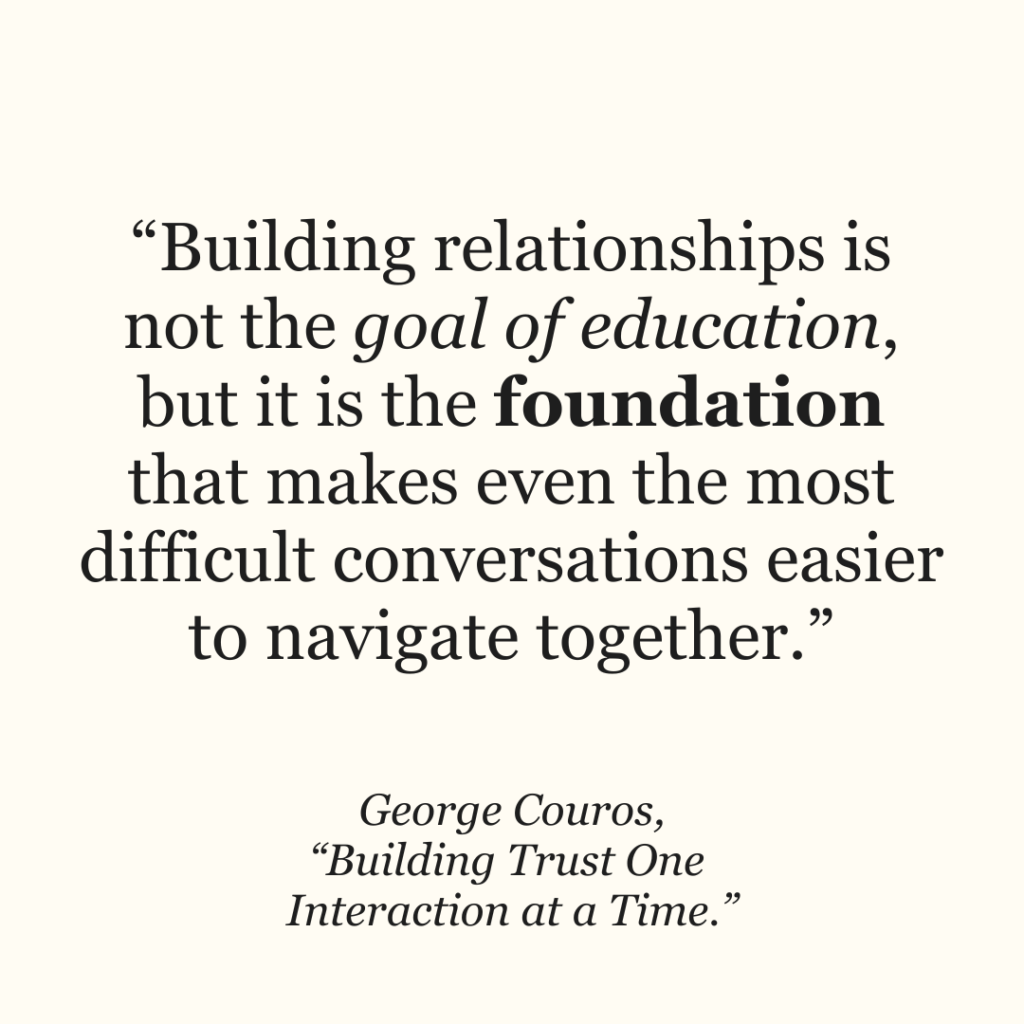
Building relationships is not the goal of education, but it is the foundation that makes even the most difficult conversations easier to navigate together.
Having a tough conversation is inevitable. It is not if, but when.
The ability to build social capital is much harder than the ability to lose it. Both take time, but unfortunately, that time varies.
Building things up can take time, but in the long run, it is an investment well worth making.
Building trust, strengthening relationships, and creating a culture where people can navigate difficult conversations together are central themes in my book, Forward, Together, and the work I do with schools and districts.
If your school community is looking to strengthen its culture, move from conflict to community, and create the conditions where students and staff can thrive, I would love to support that work through a keynote or leadership workshop.
